

03 Aug 5 Signs Your Agency Needs a Scheduling Virtual Assistant
I used to think scheduling chaos was just part of running a home care agency. Looking back, the warning signs were there all along. In this article, I share five signs that told me it was time to bring in a scheduling virtual assistant, from constantly reacting to call-offs to becoming the agency’s unofficial backup scheduler. I also talk about how partnering with TeamUp helped us streamline communication, improve scheduling response times, and free our office team to focus on more meaningful work. If your agency feels busy but never quite gets ahead, these lessons may sound very familiar.
When I first heard about hiring a scheduling virtual assistant, I honestly thought, “That sounds like something bigger agencies do.” My team was small, everyone wore multiple hats, and I figured scheduling chaos was just part of running a home care agency. Turns out, I was wrong.
Looking back, the warning signs were everywhere. I just got so used to solving one scheduling problem after another that I stopped noticing how much time, energy, and even revenue those problems were costing us. It was not one huge crisis that convinced me to change. It was a series of little moments that kept repeating until I realized our systems had not grown with the agency.
If you’re wondering whether your agency has reached that point, here are the five signs I wish I had recognized sooner.
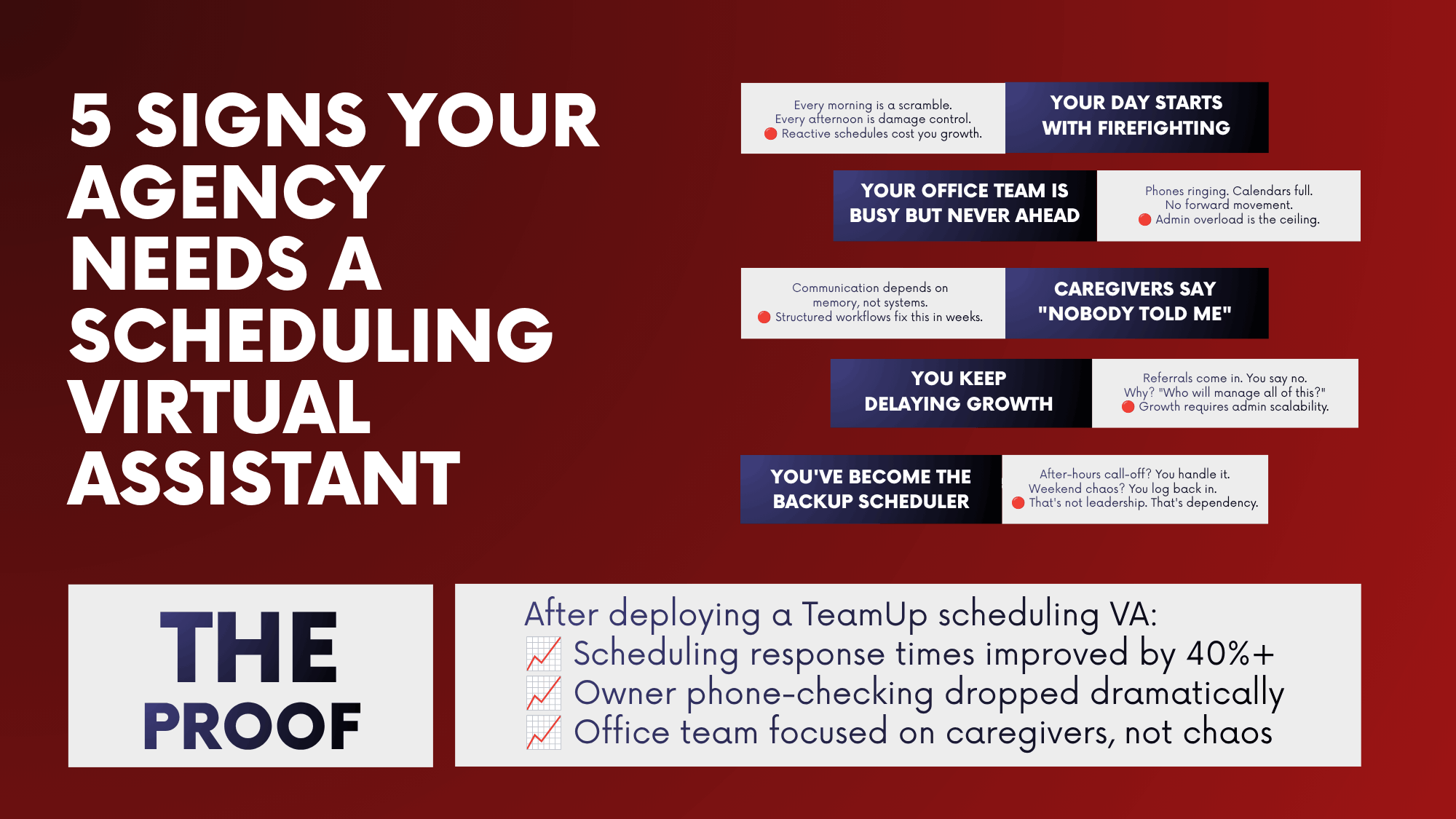
Your day starts with firefighting instead of planning, something your scheduling virtual assistant could be doing for you.
For a while, every morning followed the exact same script.
Someone called off or a caregiver forgot about a shift. A family wanted to change a visit, while a scheduler was already behind before finishing their first cup of coffee. I used to think this was just the nature of home care. I tell you now that it is not.
Yes, emergencies happen. But if every single morning feels like you’re reacting instead of leading, the issue probably isn’t your caregivers. It’s your scheduling capacity.
Take it from the Agency for Healthcare Research and Quality who notes that proactive coordination is one of the biggest factors influencing reliable healthcare operations (AHRQ, 2020). Once I read that, it clicked. We weren’t failing because people weren’t working hard. We were failing because our systems only came alive after something went wrong.
A scheduling virtual assistant gave us breathing room. Instead of reacting to every issue, someone was already confirming shifts, following up with caregivers, and catching problems before they became emergencies. I finally got to start my mornings looking at tomorrow instead of fixing yesterday.
Your office team is always busy but never gets ahead
This one took me a long time to notice. Everyone in our office looked productive because phones were ringing and messages were flying. Calendars were always open. But somehow, by the end of every day, it felt like we had barely moved forward.
The problem wasn’t effort. It was bandwidth. The American Hospital Association has pointed out that administrative overload is one of the biggest operational challenges in healthcare organizations (AHA, 2022). Home care agencies experience that same pressure.
Our coordinators were spending hours on repetitive work that absolutely needed to get done but didn’t necessarily require senior staff. These include shift confirmations, reminder calls, updating schedules, and following up on documentation. Yes, those tasks matter, but they shouldn’t consume your most experienced people. As we learned firsthand, software alone doesn’t solve this — it takes a person acting on what the system shows.
Once a scheduling virtual assistant took ownership of many of those recurring responsibilities, our office finally had time for coaching caregivers, strengthening client relationships, and improving operations instead of simply surviving the day.
Your caregivers keep saying, “Nobody told me.”
If I had a penny for every time I heard those words, I could probably fund another office. Nobody told me the client requested a different arrival time. Nobody told me the address changed. Nobody told me the family canceled.
Sometimes caregivers were right. Sometimes they simply missed the update. Either way, communication had become too dependent on individual people remembering to pass information along. The World Health Organization emphasizes that standardized communication systems improve workforce performance and reduce avoidable errors across healthcare settings (WHO, 2022). That finding matched exactly what happened in our agency.
Once communication became structured instead of improvised, misunderstandings dropped dramatically. Schedules and expectations became clearer. Everyone became less frustrated. And one of the biggest surprises was realizing that our caregivers weren’t asking for perfection. They simply wanted reliable information.
You keep delaying growth because the office can’t handle more clients, this is where scheduling virtual assistants come in.
This was probably the hardest lesson for me. We actually had opportunities to grow. Referral partners trusted us and families recommended us. Demand was there. But every time we considered expanding, someone in the office would quietly ask the same question: Who’s going to manage all of this? That question stopped us from saying yes more than once.
According to the Home Care Association of America, administrative scalability remains one of the biggest operational challenges facing growing agencies (HCAOA, 2023). Now I understand exactly why. We weren’t limited by caregivers. We were limited by office capacity, and scaling without scaling the chaos along with it felt impossible with the systems we had.
A scheduling virtual assistant changed that equation. Growth no longer automatically meant hiring another in-house scheduler before accepting more clients. Instead, we could expand administrative support alongside the agency without overwhelming our existing team. That flexibility completely changed how I thought about growth.
You’ve become the backup scheduler without realizing it
Here’s the sign I completely missed. I thought I was just being a responsible owner. Then I realized I had quietly become the backup for everything. If someone called off after hours, I handled it. If a family needed reassurance, I answered. If schedules got complicated over the weekend, I logged back in.
I convinced myself this was leadership. Eventually, I realized it was actually a symptom of a system that depended too much on me. That was the point where I partnered with TeamUp.
I was skeptical at first because I worried a remote scheduling team would require constant supervision. Instead, I found the opposite. TeamUp already understood home care workflows. Their scheduling virtual assistant handled shift confirmations, documented updates, coordinated caregiver communication, and followed escalation procedures that matched our agency’s protocols.
One week really convinced me. Three caregivers called off on the same morning because of a local flu outbreak. Normally, I would have dropped everything. Instead, TeamUp immediately contacted available caregivers, updated our scheduling platform, documented every communication, and kept families informed while our office focused on the few situations that genuinely needed management decisions.
When I looked at our monthly numbers afterward, scheduling response times had improved by more than 40 percent compared to the previous quarter. Even better, I stopped checking my phone every few minutes during dinner.
That change never appears on a dashboard, but every agency owner knows how valuable it is. TeamUp didn’t just give us administrative help. They gave us back the space to actually lead the business.
In a nutshell…
If someone had described these five signs to me a few years ago, I probably would have said, “That’s just what running a home care agency looks like.” Now I know better.
Being constantly busy is not the same as being efficient. Solving scheduling problems every day is not the same as having a reliable scheduling system. For me, bringing on a scheduling virtual assistant was less about adding another person and more about removing friction from every part of the business. Our office became calmer, our caregivers felt more supported, and our clients experienced more consistent service.
If any of these five signs sound familiar, it may not be your team that’s the problem. It may simply be that your agency has reached the point where a scheduling virtual assistant is no longer a luxury. It’s the next logical step.
To see how specialized scheduling support can transform your operations, visit TeamUp’s Healthcare Virtual Assistant Services to learn more.
References
Agency for Healthcare Research and Quality. (2020). Care Coordination Measures Atlas. U.S. Department of Health and Human Services.
American Hospital Association. (2022). Reducing Administrative Burden in Healthcare Organizations.
Home Care Association of America. (2023). 2023 Home Care Benchmarking Study.
World Health Organization. (2022). Health and Care Workforce: Strategic Directions for Workforce Planning.
I used to think scheduling chaos was just part of running a home care agency. Looking back, the warning signs were there all along. In this article, I share five signs that told me it was time to bring in a scheduling virtual assistant, from constantly reacting to call-offs to becoming the agency’s unofficial backup scheduler. I also talk about how partnering with TeamUp helped us streamline communication, improve scheduling response times, and free our office team to focus on more meaningful work. If your agency feels busy but never quite gets ahead, these lessons may sound very familiar.
When I first heard about hiring a scheduling virtual assistant, I honestly thought, “That sounds like something bigger agencies do.” My team was small, everyone wore multiple hats, and I figured scheduling chaos was just part of running a home care agency. Turns out, I was wrong.
Looking back, the warning signs were everywhere. I just got so used to solving one scheduling problem after another that I stopped noticing how much time, energy, and even revenue those problems were costing us. It was not one huge crisis that convinced me to change. It was a series of little moments that kept repeating until I realized our systems had not grown with the agency.
If you’re wondering whether your agency has reached that point, here are the five signs I wish I had recognized sooner.
Your day starts with firefighting instead of planning, something your scheduling virtual assistant could be doing for you.
For a while, every morning followed the exact same script.
Someone called off or a caregiver forgot about a shift. A family wanted to change a visit, while a scheduler was already behind before finishing their first cup of coffee. I used to think this was just the nature of home care. I tell you now that it is not.
Yes, emergencies happen. But if every single morning feels like you’re reacting instead of leading, the issue probably isn’t your caregivers. It’s your scheduling capacity.
Take it from the Agency for Healthcare Research and Quality who notes that proactive coordination is one of the biggest factors influencing reliable healthcare operations (AHRQ, 2020). Once I read that, it clicked. We weren’t failing because people weren’t working hard. We were failing because our systems only came alive after something went wrong.
A scheduling virtual assistant gave us breathing room. Instead of reacting to every issue, someone was already confirming shifts, following up with caregivers, and catching problems before they became emergencies. I finally got to start my mornings looking at tomorrow instead of fixing yesterday.
Your office team is always busy but never gets ahead
This one took me a long time to notice. Everyone in our office looked productive because phones were ringing and messages were flying. Calendars were always open. But somehow, by the end of every day, it felt like we had barely moved forward.
The problem wasn’t effort. It was bandwidth. The American Hospital Association has pointed out that administrative overload is one of the biggest operational challenges in healthcare organizations (AHA, 2022). Home care agencies experience that same pressure.
Our coordinators were spending hours on repetitive work that absolutely needed to get done but didn’t necessarily require senior staff. These include shift confirmations, reminder calls, updating schedules, and following up on documentation. Yes, those tasks matter, but they shouldn’t consume your most experienced people. As we learned firsthand, software alone doesn’t solve this — it takes a person acting on what the system shows.
Once a scheduling virtual assistant took ownership of many of those recurring responsibilities, our office finally had time for coaching caregivers, strengthening client relationships, and improving operations instead of simply surviving the day.
Your caregivers keep saying, “Nobody told me.”
If I had a penny for every time I heard those words, I could probably fund another office. Nobody told me the client requested a different arrival time. Nobody told me the address changed. Nobody told me the family canceled.
Sometimes caregivers were right. Sometimes they simply missed the update. Either way, communication had become too dependent on individual people remembering to pass information along. The World Health Organization emphasizes that standardized communication systems improve workforce performance and reduce avoidable errors across healthcare settings (WHO, 2022). That finding matched exactly what happened in our agency.
Once communication became structured instead of improvised, misunderstandings dropped dramatically. Schedules and expectations became clearer. Everyone became less frustrated. And one of the biggest surprises was realizing that our caregivers weren’t asking for perfection. They simply wanted reliable information.
You keep delaying growth because the office can’t handle more clients, this is where scheduling virtual assistants come in.
This was probably the hardest lesson for me. We actually had opportunities to grow. Referral partners trusted us and families recommended us. Demand was there. But every time we considered expanding, someone in the office would quietly ask the same question: Who’s going to manage all of this? That question stopped us from saying yes more than once.
According to the Home Care Association of America, administrative scalability remains one of the biggest operational challenges facing growing agencies (HCAOA, 2023). Now I understand exactly why. We weren’t limited by caregivers. We were limited by office capacity, and scaling without scaling the chaos along with it felt impossible with the systems we had.
A scheduling virtual assistant changed that equation. Growth no longer automatically meant hiring another in-house scheduler before accepting more clients. Instead, we could expand administrative support alongside the agency without overwhelming our existing team. That flexibility completely changed how I thought about growth.
You’ve become the backup scheduler without realizing it
Here’s the sign I completely missed. I thought I was just being a responsible owner. Then I realized I had quietly become the backup for everything. If someone called off after hours, I handled it. If a family needed reassurance, I answered. If schedules got complicated over the weekend, I logged back in.
I convinced myself this was leadership. Eventually, I realized it was actually a symptom of a system that depended too much on me. That was the point where I partnered with TeamUp.
I was skeptical at first because I worried a remote scheduling team would require constant supervision. Instead, I found the opposite. TeamUp already understood home care workflows. Their scheduling virtual assistant handled shift confirmations, documented updates, coordinated caregiver communication, and followed escalation procedures that matched our agency’s protocols.
One week really convinced me. Three caregivers called off on the same morning because of a local flu outbreak. Normally, I would have dropped everything. Instead, TeamUp immediately contacted available caregivers, updated our scheduling platform, documented every communication, and kept families informed while our office focused on the few situations that genuinely needed management decisions.
When I looked at our monthly numbers afterward, scheduling response times had improved by more than 40 percent compared to the previous quarter. Even better, I stopped checking my phone every few minutes during dinner.
That change never appears on a dashboard, but every agency owner knows how valuable it is. TeamUp didn’t just give us administrative help. They gave us back the space to actually lead the business.
In a nutshell…
If someone had described these five signs to me a few years ago, I probably would have said, “That’s just what running a home care agency looks like.” Now I know better.
Being constantly busy is not the same as being efficient. Solving scheduling problems every day is not the same as having a reliable scheduling system. For me, bringing on a scheduling virtual assistant was less about adding another person and more about removing friction from every part of the business. Our office became calmer, our caregivers felt more supported, and our clients experienced more consistent service.
If any of these five signs sound familiar, it may not be your team that’s the problem. It may simply be that your agency has reached the point where a scheduling virtual assistant is no longer a luxury. It’s the next logical step.
To see how specialized scheduling support can transform your operations, visit TeamUp’s Healthcare Virtual Assistant Services to learn more.
References
Agency for Healthcare Research and Quality. (2020). Care Coordination Measures Atlas. U.S. Department of Health and Human Services.
American Hospital Association. (2022). Reducing Administrative Burden in Healthcare Organizations.
Home Care Association of America. (2023). 2023 Home Care Benchmarking Study.
World Health Organization. (2022). Health and Care Workforce: Strategic Directions for Workforce Planning.
Sorry, the comment form is closed at this time.