

15 Jun Home Health Staffing Agency vs Internal Recruiting: Which Is More Cost-Effective?
If you own a home care agency, chances are you have wrestled with the question of whether to build your team entirely through internal recruiting or partner with a home health staffing agency. I know I have. For years, I believed that hiring in-house was the most practical path because it gave us direct control over the process. We could write the job descriptions, interview candidates ourselves, and train people according to our standards.
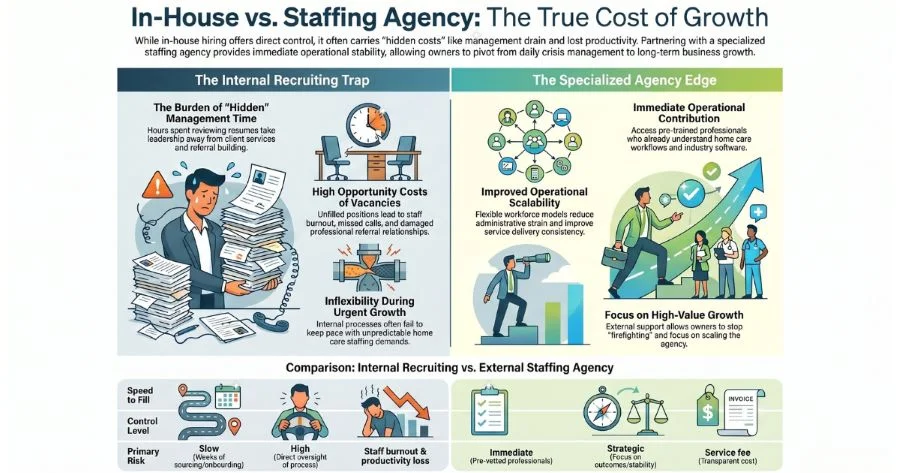
On paper, it seemed like the more economical option. Over time, however, I realized that the true cost of staffing is not measured only by salaries or recruitment fees. It is measured by the time you spend filling gaps, the opportunities you miss while recruiting, and the operational strain that falls on your team when positions remain vacant.
Many agency owners compare the hourly cost of an employee against the fee charged by a staffing partner. But here’s the catch: what often gets overlooked is the hidden cost of managing the hiring process itself. When I began looking at staffing through that lens, the conversation shifted from “Which option is cheaper?” to “Which option creates the greatest value for the agency?”
Understanding the True Cost of Internal Recruiting
Internal recruiting can be appealing because it feels familiar. You basically own the process from beginning to end. You decide where to advertise positions, how to screen applicants, and who ultimately joins the team.
The challenge is that recruiting rarely ends with making an offer. It requires continuous effort. Someone must review resumes, coordinate interviews, conduct background checks, onboard new hires, and monitor performance during the early stages of employment. For many home care agencies, those responsibilities fall on owners, care coordinators, or office staff who already have full workloads.
I learned this firsthand during a period of rapid growth. We needed additional administrative support, but every hour spent reviewing applications was an hour not spent supporting caregivers, strengthening referral relationships, or improving client services. The hiring process became a second job layered on top of the work we were already doing.
The Society for Human Resource Management (2023) notes that recruitment costs extend far beyond advertising and onboarding. Organizations must account for lost productivity, management time, and the opportunity cost associated with vacant positions. In home care, those costs can be especially significant because service delivery depends on responsiveness and continuity.
A position left unfilled for several weeks does not simply create inconvenience. It increases workload for everyone else. Schedulers absorb additional responsibilities. Supervisors spend more time answering phones. Owners find themselves stepping back into operational roles they thought they had delegated. That cost is difficult to measure on a spreadsheet, but it is very real.
Where Internal Recruiting Makes Sense
To be fair, internal recruiting is not without advantages. There are situations where it remains the right choice.
When hiring for highly specialized leadership positions or roles that require deep familiarity with your local market, recruiting internally can provide a stronger cultural fit. You maintain complete oversight throughout the process and can evaluate candidates according to the unique needs of your organization.
Internal recruiting can also be effective when growth is predictable. If you know exactly what role you need and have sufficient time to recruit, train, and integrate a new team member, the process can work well.
The issue arises when staffing needs become urgent. We all know this fact: home care does not operate according to predictable timelines. Caregivers call off. New clients start unexpectedly. Referral sources send opportunities that require immediate action. Administrative workloads increase rapidly. During those moments, the luxury of a lengthy recruitment cycle disappears.
I remember periods when our office staff were handling scheduling, on-call coverage, client communication, and recruiting all at the same time. Everyone was working hard, but the workload kept expanding faster than we could hire. Eventually, the question stopped being whether we could recruit internally. The question became whether internal recruiting alone could keep pace with the realities of operating a growing agency.
Financial Advantages of Working with a Home Health Staffing Agency
This is where a home health staffing agency enters the conversation. When many owners hear the term, they immediately think about added expense. That was my initial reaction as well. What changed my perspective was realizing how many costs were already hidden within our internal process.
A staffing partner eliminates much of the recruiting burden. Instead of spending weeks sourcing candidates, conducting multiple interviews, and managing onboarding logistics, you gain access to professionals who are already prepared for the role. That time savings creates measurable value.
For example, one of the most common challenges in home care is scheduling coverage. As described by many agency owners, mornings often begin with checking phones for overnight call-offs and scrambling to find replacement caregivers before clients are affected. When administrative support is limited, office staff become trapped in a cycle of constant reaction.
A trained remote professional can absorb many of those responsibilities immediately. Calls are answered. Schedules are monitored. Coverage efforts begin without waiting for an owner to step in.
Research from Gartner (2022) suggests that organizations using flexible workforce models often improve operational scalability while reducing administrative strain. In practice, this means fewer disruptions, faster response times, and more consistent service delivery. The financial impact becomes apparent when you consider what happens when those systems are not in place. Missed calls can lead to lost clients. Delayed responses can damage referral relationships. Staff burnout can increase turnover. Each of those outcomes carries a financial cost that often exceeds the expense of proactive staffing support.
Why Specialized Support Creates Better Long-Term Value
One lesson I learned over time is that not all staffing solutions deliver equal value. A general administrative assistant might help with basic tasks, but home care requires context. Schedulers need to understand caregiver availability, client preferences, travel times, and compliance requirements. Call handlers need to communicate with empathy because they are often speaking with stressed family members or overwhelmed caregivers.
The agencies that achieve the best outcomes are usually the ones that invest in people who already understand the industry. This is one reason specialized providers such as TeamUp have gained attention among home care agencies. Rather than supplying generic administrative support, they focus specifically on the workflows that drive home care operations.
Take it from me, the distinction matters. A professional who understands how to respond to a last-minute caregiver call-off can begin working toward coverage immediately. Someone familiar with scheduling platforms such as AxisCare already understands the importance of caregiver compatibility, shift requirements, and communication protocols. That specialized knowledge reduces training time and allows support staff to contribute more quickly.
Just as important, it helps protect internal teams from burnout. In the owner interview referenced throughout previous discussions, one recurring theme was the emotional and operational toll of constantly being on call. Agency leaders described interrupted family dinners, late-night shift coverage, and mornings that began with checking phones before getting out of bed. Those experiences are not unusual in home care. They are symptoms of systems that depend too heavily on a small number of people.
When responsibilities are distributed effectively, agencies become more resilient. Owners regain time to focus on growth, staff receive better support, and clients benefit from more consistent service.
Choosing the Most Cost-Effective Option for Your Agency
So which option is more cost-effective: internal recruiting or a home health staffing agency? The answer depends on what costs you choose to measure.
If you only compare direct hiring expenses, internal recruiting may appear less expensive. However, once you account for management time, recruitment delays, turnover risk, productivity losses, and operational disruption, the calculation becomes more complex. For many agencies, especially those experiencing growth, the more relevant question is not which option costs less today. It is which option allows the business to operate more efficiently tomorrow.
That realization changed the way I evaluate staffing decisions. I no longer look exclusively at hourly rates or recruitment fees. I look at how quickly support can be deployed, how effectively it reduces workload, and how much operational stability it creates. I consider whether my team can focus on serving clients instead of constantly managing staffing challenges.
In many cases, the most cost-effective solution is not choosing one approach over the other. It is combining both. Internal recruiting remains valuable for certain strategic roles, while a staffing partner provides immediate support for operational functions that directly affect day-to-day performance. The agencies that grow sustainably are usually the ones that understand this balance. They recognize that staffing is not simply an expense. It is an investment in service quality, team stability, and long-term scalability.
At the end of the day, partnering with a home health staffing agency is not about replacing your team. It is about giving your agency the support structure it needs to grow without placing every responsibility on the same group of people. When you evaluate the full picture, including time, productivity, retention, and operational consistency, the most cost-effective decision is often the one that gives you the freedom to focus less on staffing problems and more on delivering exceptional care.
References
American Psychological Association. (2006). Multitasking: Switching costs.
Gartner. (2022). Future of work trends and workforce flexibility.
Institute for Healthcare Improvement. (2019). Improving care coordination and service reliability.
Society for Human Resource Management. (2023). The true cost of recruiting and hiring employees.
World Health Organization. (2019). Delivering integrated care for older people.
World Economic Forum. (2020). The future of jobs and remote work.
If you own a home care agency, chances are you have wrestled with the question of whether to build your team entirely through internal recruiting or partner with a home health staffing agency. I know I have. For years, I believed that hiring in-house was the most practical path because it gave us direct control over the process. We could write the job descriptions, interview candidates ourselves, and train people according to our standards.
On paper, it seemed like the more economical option. Over time, however, I realized that the true cost of staffing is not measured only by salaries or recruitment fees. It is measured by the time you spend filling gaps, the opportunities you miss while recruiting, and the operational strain that falls on your team when positions remain vacant.
Many agency owners compare the hourly cost of an employee against the fee charged by a staffing partner. But here’s the catch: what often gets overlooked is the hidden cost of managing the hiring process itself. When I began looking at staffing through that lens, the conversation shifted from “Which option is cheaper?” to “Which option creates the greatest value for the agency?”
Understanding the True Cost of Internal Recruiting
Internal recruiting can be appealing because it feels familiar. You basically own the process from beginning to end. You decide where to advertise positions, how to screen applicants, and who ultimately joins the team.
The challenge is that recruiting rarely ends with making an offer. It requires continuous effort. Someone must review resumes, coordinate interviews, conduct background checks, onboard new hires, and monitor performance during the early stages of employment. For many home care agencies, those responsibilities fall on owners, care coordinators, or office staff who already have full workloads.
I learned this firsthand during a period of rapid growth. We needed additional administrative support, but every hour spent reviewing applications was an hour not spent supporting caregivers, strengthening referral relationships, or improving client services. The hiring process became a second job layered on top of the work we were already doing.
The Society for Human Resource Management (2023) notes that recruitment costs extend far beyond advertising and onboarding. Organizations must account for lost productivity, management time, and the opportunity cost associated with vacant positions. In home care, those costs can be especially significant because service delivery depends on responsiveness and continuity.
A position left unfilled for several weeks does not simply create inconvenience. It increases workload for everyone else. Schedulers absorb additional responsibilities. Supervisors spend more time answering phones. Owners find themselves stepping back into operational roles they thought they had delegated. That cost is difficult to measure on a spreadsheet, but it is very real.
Where Internal Recruiting Makes Sense
To be fair, internal recruiting is not without advantages. There are situations where it remains the right choice.
When hiring for highly specialized leadership positions or roles that require deep familiarity with your local market, recruiting internally can provide a stronger cultural fit. You maintain complete oversight throughout the process and can evaluate candidates according to the unique needs of your organization.
Internal recruiting can also be effective when growth is predictable. If you know exactly what role you need and have sufficient time to recruit, train, and integrate a new team member, the process can work well.
The issue arises when staffing needs become urgent. We all know this fact: home care does not operate according to predictable timelines. Caregivers call off. New clients start unexpectedly. Referral sources send opportunities that require immediate action. Administrative workloads increase rapidly. During those moments, the luxury of a lengthy recruitment cycle disappears.
I remember periods when our office staff were handling scheduling, on-call coverage, client communication, and recruiting all at the same time. Everyone was working hard, but the workload kept expanding faster than we could hire. Eventually, the question stopped being whether we could recruit internally. The question became whether internal recruiting alone could keep pace with the realities of operating a growing agency.
Financial Advantages of Working with a Home Health Staffing Agency
This is where a home health staffing agency enters the conversation. When many owners hear the term, they immediately think about added expense. That was my initial reaction as well. What changed my perspective was realizing how many costs were already hidden within our internal process.
A staffing partner eliminates much of the recruiting burden. Instead of spending weeks sourcing candidates, conducting multiple interviews, and managing onboarding logistics, you gain access to professionals who are already prepared for the role. That time savings creates measurable value.
For example, one of the most common challenges in home care is scheduling coverage. As described by many agency owners, mornings often begin with checking phones for overnight call-offs and scrambling to find replacement caregivers before clients are affected. When administrative support is limited, office staff become trapped in a cycle of constant reaction.
A trained remote professional can absorb many of those responsibilities immediately. Calls are answered. Schedules are monitored. Coverage efforts begin without waiting for an owner to step in.
Research from Gartner (2022) suggests that organizations using flexible workforce models often improve operational scalability while reducing administrative strain. In practice, this means fewer disruptions, faster response times, and more consistent service delivery. The financial impact becomes apparent when you consider what happens when those systems are not in place. Missed calls can lead to lost clients. Delayed responses can damage referral relationships. Staff burnout can increase turnover. Each of those outcomes carries a financial cost that often exceeds the expense of proactive staffing support.
Why Specialized Support Creates Better Long-Term Value
One lesson I learned over time is that not all staffing solutions deliver equal value. A general administrative assistant might help with basic tasks, but home care requires context. Schedulers need to understand caregiver availability, client preferences, travel times, and compliance requirements. Call handlers need to communicate with empathy because they are often speaking with stressed family members or overwhelmed caregivers.
The agencies that achieve the best outcomes are usually the ones that invest in people who already understand the industry. This is one reason specialized providers such as TeamUp have gained attention among home care agencies. Rather than supplying generic administrative support, they focus specifically on the workflows that drive home care operations.
Take it from me, the distinction matters. A professional who understands how to respond to a last-minute caregiver call-off can begin working toward coverage immediately. Someone familiar with scheduling platforms such as AxisCare already understands the importance of caregiver compatibility, shift requirements, and communication protocols. That specialized knowledge reduces training time and allows support staff to contribute more quickly.
Just as important, it helps protect internal teams from burnout. In the owner interview referenced throughout previous discussions, one recurring theme was the emotional and operational toll of constantly being on call. Agency leaders described interrupted family dinners, late-night shift coverage, and mornings that began with checking phones before getting out of bed. Those experiences are not unusual in home care. They are symptoms of systems that depend too heavily on a small number of people.
When responsibilities are distributed effectively, agencies become more resilient. Owners regain time to focus on growth, staff receive better support, and clients benefit from more consistent service.
Choosing the Most Cost-Effective Option for Your Agency
So which option is more cost-effective: internal recruiting or a home health staffing agency? The answer depends on what costs you choose to measure.
If you only compare direct hiring expenses, internal recruiting may appear less expensive. However, once you account for management time, recruitment delays, turnover risk, productivity losses, and operational disruption, the calculation becomes more complex. For many agencies, especially those experiencing growth, the more relevant question is not which option costs less today. It is which option allows the business to operate more efficiently tomorrow.
That realization changed the way I evaluate staffing decisions. I no longer look exclusively at hourly rates or recruitment fees. I look at how quickly support can be deployed, how effectively it reduces workload, and how much operational stability it creates. I consider whether my team can focus on serving clients instead of constantly managing staffing challenges.
In many cases, the most cost-effective solution is not choosing one approach over the other. It is combining both. Internal recruiting remains valuable for certain strategic roles, while a staffing partner provides immediate support for operational functions that directly affect day-to-day performance. The agencies that grow sustainably are usually the ones that understand this balance. They recognize that staffing is not simply an expense. It is an investment in service quality, team stability, and long-term scalability.
At the end of the day, partnering with a home health staffing agency is not about replacing your team. It is about giving your agency the support structure it needs to grow without placing every responsibility on the same group of people. When you evaluate the full picture, including time, productivity, retention, and operational consistency, the most cost-effective decision is often the one that gives you the freedom to focus less on staffing problems and more on delivering exceptional care.
References
American Psychological Association. (2006). Multitasking: Switching costs.
Gartner. (2022). Future of work trends and workforce flexibility.
Institute for Healthcare Improvement. (2019). Improving care coordination and service reliability.
Society for Human Resource Management. (2023). The true cost of recruiting and hiring employees.
World Health Organization. (2019). Delivering integrated care for older people.
World Economic Forum. (2020). The future of jobs and remote work.
Sorry, the comment form is closed at this time.