

31 Jul 7 Staffing Mistakes That Slow Down Home Care Agency Growth
Building a successful staffing home care agency is about much more than filling open positions. In this article, I share seven staffing mistakes I made as an agency owner and the lessons that helped us grow more sustainably. From hiring too quickly and overlooking caregiver preferences to underinvesting in administrative support, each mistake taught me something valuable about leading a stronger team. I also discuss how partnering with TeamUp helped streamline our operations and free our office staff to focus on higher-value work. If you’re looking to strengthen your agency, these lessons may help you avoid the same costly mistakes.
When I first started building my staffing home care agency, I thought success depended on finding more caregivers. The assumption seemed logical, right? More caregivers meant more clients, more revenue, and more growth. It is that simple! But it took several years for me to realize that staffing is not just about filling vacancies. It is about making hundreds of decisions that either strengthen or weaken your agency over time.
Looking back, many of the challenges we faced were not caused by a shortage of caregivers. They were the result of mistakes in how we recruited, supported, scheduled, and managed the people we already had. Some lessons were expensive. Others cost us good employees we should have kept.
If I could start over today, these are the seven staffing mistakes I would avoid.
Hiring too quickly to solve immediate problems.
One of the biggest traps I fell into was hiring reactively. Whenever client demand increased, my instinct was to recruit as many caregivers as possible. The focus became speed instead of fit.
The result was predictable. Some caregivers were excellent, but others were never truly aligned with our expectations or culture. Within a few months, turnover increased, and we were back where we started.
The Society for Human Resource Management (SHRM, 2023) notes that poor hiring decisions create significant financial costs through recruitment expenses, retraining, and lost productivity. And I couldn’t agree more. I learned that slowing down the hiring process often helped us grow faster because we spent less time replacing unsuitable hires.
Assuming orientation ends after the first week of working in staffing home care
For a long time, I believed orientation was an event. A caregiver completed onboarding, reviewed policies, shadowed another employee, and then officially joined the schedule. That’s basically it. But the reality was different.
Many caregivers struggled during their first three months because they needed continued guidance, not just initial training. In fact, the Home Care Association of America (HCAOA, 2023) consistently identifies ongoing support and communication as major contributors to caregiver retention.
After introducing structured thirty-day and ninety-day check-ins, we noticed caregivers became more confident and asked questions earlier rather than waiting until problems became serious. Looking back, onboarding was never really about paperwork. It was about building confidence.
Ignoring caregiver preferences
Early in my career, I viewed scheduling almost entirely from the agency’s perspective. We assigned shifts based on operational needs without asking enough about caregiver preferences.
Eventually, patterns emerged. Some caregivers preferred shorter visits. Others wanted consistent weekday schedules. Some were willing to travel farther for longer shifts but disliked fragmented assignments.
When we started collecting and using this information, attendance improved noticeably. Research from the World Health Organization (WHO, 2022) emphasizes that employee engagement improves when work arrangements better reflect workforce needs and preferences.
Listening to caregivers turned out to be one of the simplest staffing improvements we ever made. We learned this in working with a reputable staffing home care agency.
Measuring staffing success only by filled shifts
This mistake took me years to recognize. I always celebrated whenever the schedule looked full. The problem was that a full schedule did not always mean a healthy operation.
Some caregivers were quietly burning out. Others were accepting too many shifts simply because they felt obligated. Some clients were seeing different caregivers every week. Eventually, I stopped asking, “Did we fill every visit?” Instead, I asked better questions. Were caregivers staying? Were clients receiving consistent care? Were supervisors spending less time resolving staffing problems? Those questions gave us a much clearer picture of agency health.
The Agency for Healthcare Research and Quality (AHRQ, 2020) notes that continuity and coordination contribute significantly to quality outcomes across healthcare settings. That reminded me that staffing quality matters just as much as staffing quantity.
Waiting too long to strengthen administrative support by delaying help from staffing home care agencies
One lesson I wish I had learned earlier had very little to do with caregivers themselves. It had everything to do with the office. Our coordinators were juggling scheduling, documentation, caregiver communication, family updates, payroll questions, and incoming inquiries. As the agency grew, the administrative workload increased faster than our client census.
Eventually, we partnered with TeamUp. At first, I wondered whether remote administrative support would actually reduce the burden or simply create another layer of coordination. The opposite happened.
Routine scheduling confirmations, documentation follow-ups, and caregiver communication became far more organized because TeamUp followed structured workflows designed specifically for home care operations. One example stood out during a particularly busy holiday season. We experienced several caregiver call-offs within a single morning. Instead of our office becoming overwhelmed, TeamUp handled the first wave of communication, contacted available caregivers based on our protocols, updated documentation, and kept families informed while our internal team focused on higher-level decisions.
The difference was noticeable almost immediately. Our coordinators stopped spending entire days reacting to emergencies. Instead, they had time to coach caregivers, strengthen client relationships, and improve operations.
For me, TeamUp did not replace our office team. It gave them room to do the work that truly required their expertise.
Failing to use staffing data for decision-making
I used to think staffing decisions were mostly based on instinct. Over time, I realized instinct improves dramatically when supported by data. We began tracking caregiver turnover, overtime, commute distances, call-off frequency, referral sources, and time-to-fill open shifts.
That’s when patterns quickly emerged. Some recruiting channels consistently produced stronger long-term caregivers. Certain geographic areas generated more scheduling challenges. Specific shift types had higher cancellation rates.
The Centers for Medicare & Medicaid Services (CMS, 2023) continues to encourage data-driven quality improvement throughout healthcare delivery, and I found the same principle useful in managing staffing.
Remember this: the numbers rarely solved problems on their own. They simply helped us ask better questions.
Thinking staffing problems eventually solve themselves
Perhaps the biggest mistake I made was believing that staffing challenges would naturally improve as the agency became larger. Guess what? They did not.
Growth amplified every weakness already present. Poor communication became bigger communication problems. Weak hiring became higher turnover. Disorganized scheduling became operational chaos.
But don’t get me wrong. The agencies I admire most are not the ones with perfect staffing. They are the ones that address staffing problems while they are still small. Every improvement compounds. Every delay compounds too. That mindset changed how I lead my agency today.
Main takeaway
The mistakes I made were not unusual. Many owners experience the same growing pains. The important part is recognizing them early enough to make meaningful changes. For me, those changes included hiring more deliberately, investing in caregiver support, listening more closely, measuring better outcomes, using operational data, and partnering with organizations like TeamUp that strengthened our administrative foundation rather than adding more complexity.
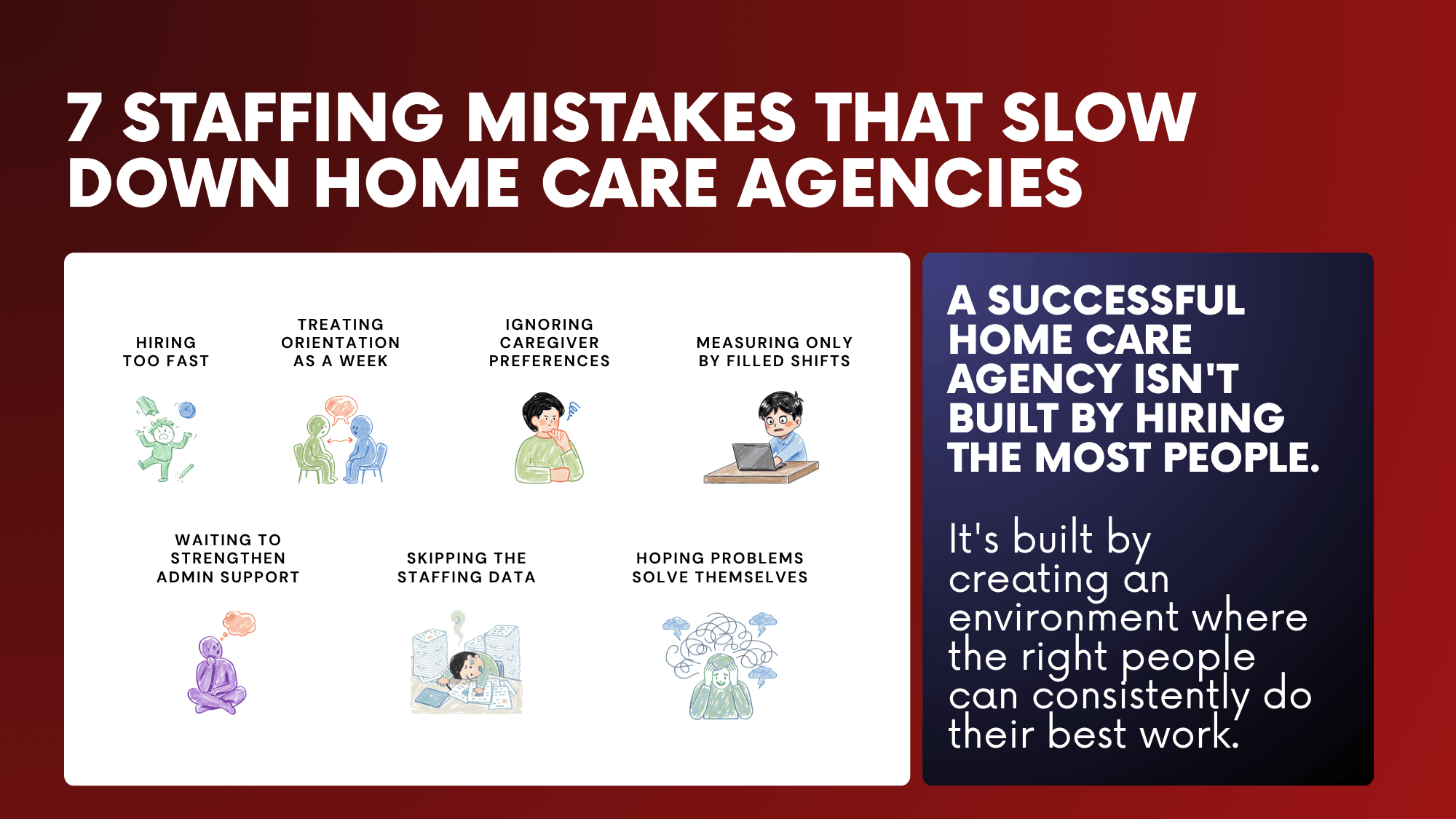
If there is one lesson I hope fellow owners take away, it is this. A successful staffing home care agency is not built by hiring the most people. It is built by creating an environment where the right people can consistently do their best work.
References
Agency for Healthcare Research and Quality. (2020). Care Coordination Measures Atlas. U.S. Department of Health and Human Services.
Centers for Medicare & Medicaid Services. (2023). Home Health Quality Reporting Program.
Home Care Association of America. (2023). 2023 Home Care Benchmarking Study.
Society for Human Resource Management. (2023). Human Capital Benchmarking Report.
World Health Organization. (2022). Health and Care Workforce: Strategic Directions.
Building a successful staffing home care agency is about much more than filling open positions. In this article, I share seven staffing mistakes I made as an agency owner and the lessons that helped us grow more sustainably. From hiring too quickly and overlooking caregiver preferences to underinvesting in administrative support, each mistake taught me something valuable about leading a stronger team. I also discuss how partnering with TeamUp helped streamline our operations and free our office staff to focus on higher-value work. If you’re looking to strengthen your agency, these lessons may help you avoid the same costly mistakes.
When I first started building my staffing home care agency, I thought success depended on finding more caregivers. The assumption seemed logical, right? More caregivers meant more clients, more revenue, and more growth. It is that simple! But it took several years for me to realize that staffing is not just about filling vacancies. It is about making hundreds of decisions that either strengthen or weaken your agency over time.
Looking back, many of the challenges we faced were not caused by a shortage of caregivers. They were the result of mistakes in how we recruited, supported, scheduled, and managed the people we already had. Some lessons were expensive. Others cost us good employees we should have kept.
If I could start over today, these are the seven staffing mistakes I would avoid.
Hiring too quickly to solve immediate problems.
One of the biggest traps I fell into was hiring reactively. Whenever client demand increased, my instinct was to recruit as many caregivers as possible. The focus became speed instead of fit.
The result was predictable. Some caregivers were excellent, but others were never truly aligned with our expectations or culture. Within a few months, turnover increased, and we were back where we started.
The Society for Human Resource Management (SHRM, 2023) notes that poor hiring decisions create significant financial costs through recruitment expenses, retraining, and lost productivity. And I couldn’t agree more. I learned that slowing down the hiring process often helped us grow faster because we spent less time replacing unsuitable hires.
Assuming orientation ends after the first week of working in staffing home care
For a long time, I believed orientation was an event. A caregiver completed onboarding, reviewed policies, shadowed another employee, and then officially joined the schedule. That’s basically it. But the reality was different.
Many caregivers struggled during their first three months because they needed continued guidance, not just initial training. In fact, the Home Care Association of America (HCAOA, 2023) consistently identifies ongoing support and communication as major contributors to caregiver retention.
After introducing structured thirty-day and ninety-day check-ins, we noticed caregivers became more confident and asked questions earlier rather than waiting until problems became serious. Looking back, onboarding was never really about paperwork. It was about building confidence.
Ignoring caregiver preferences
Early in my career, I viewed scheduling almost entirely from the agency’s perspective. We assigned shifts based on operational needs without asking enough about caregiver preferences.
Eventually, patterns emerged. Some caregivers preferred shorter visits. Others wanted consistent weekday schedules. Some were willing to travel farther for longer shifts but disliked fragmented assignments.
When we started collecting and using this information, attendance improved noticeably. Research from the World Health Organization (WHO, 2022) emphasizes that employee engagement improves when work arrangements better reflect workforce needs and preferences.
Listening to caregivers turned out to be one of the simplest staffing improvements we ever made. We learned this in working with a reputable staffing home care agency.
Measuring staffing success only by filled shifts
This mistake took me years to recognize. I always celebrated whenever the schedule looked full. The problem was that a full schedule did not always mean a healthy operation.
Some caregivers were quietly burning out. Others were accepting too many shifts simply because they felt obligated. Some clients were seeing different caregivers every week. Eventually, I stopped asking, “Did we fill every visit?” Instead, I asked better questions. Were caregivers staying? Were clients receiving consistent care? Were supervisors spending less time resolving staffing problems? Those questions gave us a much clearer picture of agency health.
The Agency for Healthcare Research and Quality (AHRQ, 2020) notes that continuity and coordination contribute significantly to quality outcomes across healthcare settings. That reminded me that staffing quality matters just as much as staffing quantity.
Waiting too long to strengthen administrative support by delaying help from staffing home care agencies
One lesson I wish I had learned earlier had very little to do with caregivers themselves. It had everything to do with the office. Our coordinators were juggling scheduling, documentation, caregiver communication, family updates, payroll questions, and incoming inquiries. As the agency grew, the administrative workload increased faster than our client census.
Eventually, we partnered with TeamUp. At first, I wondered whether remote administrative support would actually reduce the burden or simply create another layer of coordination. The opposite happened.
Routine scheduling confirmations, documentation follow-ups, and caregiver communication became far more organized because TeamUp followed structured workflows designed specifically for home care operations. One example stood out during a particularly busy holiday season. We experienced several caregiver call-offs within a single morning. Instead of our office becoming overwhelmed, TeamUp handled the first wave of communication, contacted available caregivers based on our protocols, updated documentation, and kept families informed while our internal team focused on higher-level decisions.
The difference was noticeable almost immediately. Our coordinators stopped spending entire days reacting to emergencies. Instead, they had time to coach caregivers, strengthen client relationships, and improve operations.
For me, TeamUp did not replace our office team. It gave them room to do the work that truly required their expertise.
Failing to use staffing data for decision-making
I used to think staffing decisions were mostly based on instinct. Over time, I realized instinct improves dramatically when supported by data. We began tracking caregiver turnover, overtime, commute distances, call-off frequency, referral sources, and time-to-fill open shifts.
That’s when patterns quickly emerged. Some recruiting channels consistently produced stronger long-term caregivers. Certain geographic areas generated more scheduling challenges. Specific shift types had higher cancellation rates.
The Centers for Medicare & Medicaid Services (CMS, 2023) continues to encourage data-driven quality improvement throughout healthcare delivery, and I found the same principle useful in managing staffing.
Remember this: the numbers rarely solved problems on their own. They simply helped us ask better questions.
Thinking staffing problems eventually solve themselves
Perhaps the biggest mistake I made was believing that staffing challenges would naturally improve as the agency became larger. Guess what? They did not.
Growth amplified every weakness already present. Poor communication became bigger communication problems. Weak hiring became higher turnover. Disorganized scheduling became operational chaos.
But don’t get me wrong. The agencies I admire most are not the ones with perfect staffing. They are the ones that address staffing problems while they are still small. Every improvement compounds. Every delay compounds too. That mindset changed how I lead my agency today.
Main takeaway
The mistakes I made were not unusual. Many owners experience the same growing pains. The important part is recognizing them early enough to make meaningful changes. For me, those changes included hiring more deliberately, investing in caregiver support, listening more closely, measuring better outcomes, using operational data, and partnering with organizations like TeamUp that strengthened our administrative foundation rather than adding more complexity.
If there is one lesson I hope fellow owners take away, it is this. A successful staffing home care agency is not built by hiring the most people. It is built by creating an environment where the right people can consistently do their best work.
References
Agency for Healthcare Research and Quality. (2020). Care Coordination Measures Atlas. U.S. Department of Health and Human Services.
Centers for Medicare & Medicaid Services. (2023). Home Health Quality Reporting Program.
Home Care Association of America. (2023). 2023 Home Care Benchmarking Study.
Society for Human Resource Management. (2023). Human Capital Benchmarking Report.
World Health Organization. (2022). Health and Care Workforce: Strategic Directions.
Sorry, the comment form is closed at this time.