

22 Jun How Home Caregiving Agencies Reduce Missed Visits and No-Shows
If you talk to enough owners of home caregiving agencies, you’ll eventually discover that missed visits and caregiver no-shows are not occasional problems. They are operational threats. A single missed visit can create a chain reaction that affects client trust, caregiver morale, referral relationships, and revenue. I learned this lesson early in my agency journey. At first, I thought no-shows were simply part of the business. Caregivers get sick, cars break down, and emergencies happen. Over time, however, I realized that while you cannot eliminate every disruption, you can build systems that dramatically reduce how often they happen and how severely they affect your agency when they do.
Many owners focus on filling schedules. The home caregiving agencies that consistently deliver excellent service focus on protecting schedules. You must understand that there is a difference. Filling a shift is a task. Protecting a shift requires planning, communication, accountability, and contingency systems working together. After years of trial and error, I have found that the most successful home caregiving agencies share several practices that help them reduce missed visits and no-shows before they become major problems.
1. Confirm Every Shift Before It Becomes a Problem
One of the biggest mistakes I see agencies make is assuming that a scheduled shift is a guaranteed shift. Just because a caregiver accepted an assignment three days ago does not mean they will remember every detail or show up without issue. Life happens. People forget. Circumstances change.
That is why our agency adopted a proactive confirmation process. Every upcoming shift receives confirmation before service begins. Depending on the situation, that may involve text reminders, automated notifications, or direct outreach from scheduling staff.
This may seem excessive at first, but research consistently shows that reminder systems reduce missed appointments and improve attendance rates across healthcare settings (Agency for Healthcare Research and Quality, 2020). The same principle applies to home care.
I remember one caregiver who had accidentally mixed up two client addresses after accepting multiple shifts during the week. A simple confirmation call the evening before caught the mistake. Without that conversation, the client would have been waiting for care that never arrived.
Many missed visits are not caused by negligence. They happen because nobody verified the details before the shift started.
2. Build a Real-Time Coverage System
No matter how strong your scheduling process is, caregiver call-offs will happen. The question is not whether someone will call out. The question is how quickly your agency can respond when it happens.
For years, our biggest challenge was speed. A caregiver would call off an hour before a shift, and we would immediately begin calling every available employee one by one. By the time we found coverage, the client was already frustrated.
Eventually, we developed a structured coverage workflow. When a call-off occurs, the first step is immediate shift removal. Next, we identify caregivers who meet several criteria: availability, proximity to the client, appropriate skills, and compatibility with the care plan. Then targeted communication begins immediately. This process mirrors best practices in workforce management, where rapid response systems reduce service disruptions and improve continuity of care (Institute for Healthcare Improvement, 2019).
The key is having someone actively managing the process. Software can identify available caregivers, but someone still needs to evaluate options, communicate with staff, confirm coverage, and update the family. The faster those actions occur, the lower the likelihood that a missed visit turns into a client complaint.
3. Track Patterns Instead of Treating Every No-Show as an Isolated Incident
One lesson that took me years to learn was that no-shows rarely happen randomly. When we started tracking attendance data more closely, patterns emerged. Certain shifts experienced more call-offs. Specific travel routes created challenges. Some caregivers consistently struggled with early morning assignments. Once we began looking at trends rather than individual incidents, solutions became easier to implement.
For example, we discovered that several caregivers were accepting assignments that required longer commutes than they were realistically willing to maintain. On paper, they appeared available. In practice, the travel burden increased cancellations. Research on workforce retention suggests that commute times, workload expectations, and scheduling compatibility significantly influence attendance and reliability (World Health Organization, 2021).
As agency owners, we sometimes focus on filling open shifts without asking whether those assignments are sustainable for the caregiver. A filled shift today is not necessarily a stable shift tomorrow. Reducing no-shows often begins with identifying the operational conditions that contribute to them in the first place.
4. Strengthen Communication Between Families, Caregivers, and the Office
Most missed visits are scheduling failures. Some, however, are communication failures. I have seen situations where caregivers believed a client canceled a visit while the client believed the caregiver was still coming. I have seen families request schedule changes that never reached the right person. I have seen misunderstandings create frustration even when everyone involved had good intentions.
This is why communication systems matter just as much as scheduling systems. Every schedule adjustment should be documented. Every change should be confirmed. Every stakeholder should receive the same information. The Agency for Healthcare Research and Quality (2020) notes that communication breakdowns remain one of the leading causes of service disruptions across healthcare settings. Home care is no exception.
One practice that significantly improved our operations was assigning ownership of communication. Instead of assuming information would naturally reach the right people, we designated responsibility for confirming updates and documenting changes. That accountability reduced confusion and improved consistency. Families felt informed. Caregivers felt supported. Office staff spent less time untangling misunderstandings.
5. Create Backup Capacity Before You Need It
Perhaps the most effective strategy we adopted was maintaining backup capacity. Many agencies wait until a problem occurs before searching for a solution. Unfortunately, by that point, options become limited.
We learned to maintain a roster of caregivers who were interested in additional hours, available for emergency assignments, or willing to provide short-notice coverage. Building that network required effort, but it paid dividends when unexpected call-offs occurred.
The same principle applies to administrative support. Several years ago, our office team was handling scheduling, call management, client communication, and emergency coverage simultaneously. Everyone worked hard, but the workload became overwhelming whenever staffing disruptions occurred. That experience taught us the value of having additional operational support available before it became necessary.
A Case Study in Preventing Missed Visits
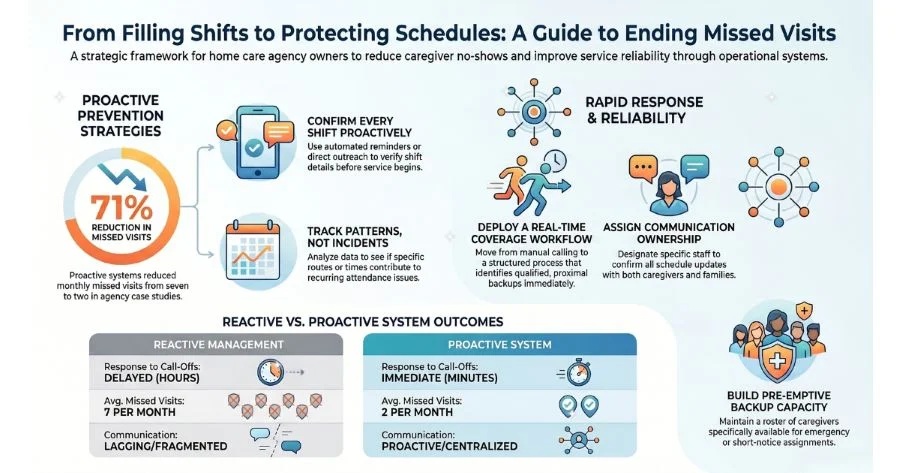
Years ago, our agency experienced frequent no-shows, averaging seven missed visits per month. The primary issue was not caregiver availability. It was communication lag. Call-offs were reported, but replacement efforts often began too late. We partnered with TeamUp to provide dedicated scheduling and call management support.
Within three months, every caregiver call-off triggered an immediate response workflow. Coverage requests were sent within minutes instead of hours. Families received proactive updates whenever caregiver changes occurred. Shift confirmations were completed daily.
The result was a reduction in missed visits from seven per month to two per month, along with a measurable increase in client satisfaction scores. The technology remained the same. The caregivers remained largely the same. What changed was the consistency of execution.
Why TeamUp Makes a Difference
Many staffing providers focus primarily on filling positions. TeamUp focuses on supporting the operational systems that keep visits from being missed in the first place. Their virtual assistants understand home care workflows, scheduling priorities, caregiver communication, and client expectations. They are trained to monitor schedules actively, coordinate coverage quickly, and maintain communication throughout the process.
For home caregiving agencies, that support creates a layer of protection that many internal teams struggle to maintain consistently, especially during periods of growth. The value is not simply that someone answers the phone. The value is having someone who understands what to do next when that phone rings.
Remember, the most successful home caregiving agencies do not eliminate caregiver call-offs, transportation issues, or unexpected emergencies. Those challenges are part of the business. What separates high-performing agencies from everyone else is how they prepare for those disruptions.
By confirming shifts proactively, building structured coverage systems, tracking attendance patterns, strengthening communication, and maintaining backup capacity, agencies can dramatically reduce missed visits and no-shows.
Most importantly, they can protect the trust that clients and families place in them every day. Because in home caregiving agencies, reliability is not just an operational goal. It is one of the clearest ways we demonstrate that we care.
References
Agency for Healthcare Research and Quality. (2020). Care coordination measures atlas.
Institute for Healthcare Improvement. (2019). Improving care coordination and service reliability.
World Health Organization. (2021). Global strategy on human resources for health: Workforce support and retention.
Journal of Patient Experience. (2021). The role of communication and trust in patient satisfaction.
Project Management Institute. (2021). The importance of standardized workflows in service delivery.
If you talk to enough owners of home caregiving agencies, you’ll eventually discover that missed visits and caregiver no-shows are not occasional problems. They are operational threats. A single missed visit can create a chain reaction that affects client trust, caregiver morale, referral relationships, and revenue. I learned this lesson early in my agency journey. At first, I thought no-shows were simply part of the business. Caregivers get sick, cars break down, and emergencies happen. Over time, however, I realized that while you cannot eliminate every disruption, you can build systems that dramatically reduce how often they happen and how severely they affect your agency when they do.
Many owners focus on filling schedules. The home caregiving agencies that consistently deliver excellent service focus on protecting schedules. You must understand that there is a difference. Filling a shift is a task. Protecting a shift requires planning, communication, accountability, and contingency systems working together. After years of trial and error, I have found that the most successful home caregiving agencies share several practices that help them reduce missed visits and no-shows before they become major problems.
1. Confirm Every Shift Before It Becomes a Problem
One of the biggest mistakes I see agencies make is assuming that a scheduled shift is a guaranteed shift. Just because a caregiver accepted an assignment three days ago does not mean they will remember every detail or show up without issue. Life happens. People forget. Circumstances change.
That is why our agency adopted a proactive confirmation process. Every upcoming shift receives confirmation before service begins. Depending on the situation, that may involve text reminders, automated notifications, or direct outreach from scheduling staff.
This may seem excessive at first, but research consistently shows that reminder systems reduce missed appointments and improve attendance rates across healthcare settings (Agency for Healthcare Research and Quality, 2020). The same principle applies to home care.
I remember one caregiver who had accidentally mixed up two client addresses after accepting multiple shifts during the week. A simple confirmation call the evening before caught the mistake. Without that conversation, the client would have been waiting for care that never arrived.
Many missed visits are not caused by negligence. They happen because nobody verified the details before the shift started.
2. Build a Real-Time Coverage System
No matter how strong your scheduling process is, caregiver call-offs will happen. The question is not whether someone will call out. The question is how quickly your agency can respond when it happens.
For years, our biggest challenge was speed. A caregiver would call off an hour before a shift, and we would immediately begin calling every available employee one by one. By the time we found coverage, the client was already frustrated.
Eventually, we developed a structured coverage workflow. When a call-off occurs, the first step is immediate shift removal. Next, we identify caregivers who meet several criteria: availability, proximity to the client, appropriate skills, and compatibility with the care plan. Then targeted communication begins immediately. This process mirrors best practices in workforce management, where rapid response systems reduce service disruptions and improve continuity of care (Institute for Healthcare Improvement, 2019).
The key is having someone actively managing the process. Software can identify available caregivers, but someone still needs to evaluate options, communicate with staff, confirm coverage, and update the family. The faster those actions occur, the lower the likelihood that a missed visit turns into a client complaint.
3. Track Patterns Instead of Treating Every No-Show as an Isolated Incident
One lesson that took me years to learn was that no-shows rarely happen randomly. When we started tracking attendance data more closely, patterns emerged. Certain shifts experienced more call-offs. Specific travel routes created challenges. Some caregivers consistently struggled with early morning assignments. Once we began looking at trends rather than individual incidents, solutions became easier to implement.
For example, we discovered that several caregivers were accepting assignments that required longer commutes than they were realistically willing to maintain. On paper, they appeared available. In practice, the travel burden increased cancellations. Research on workforce retention suggests that commute times, workload expectations, and scheduling compatibility significantly influence attendance and reliability (World Health Organization, 2021).
As agency owners, we sometimes focus on filling open shifts without asking whether those assignments are sustainable for the caregiver. A filled shift today is not necessarily a stable shift tomorrow. Reducing no-shows often begins with identifying the operational conditions that contribute to them in the first place.
4. Strengthen Communication Between Families, Caregivers, and the Office
Most missed visits are scheduling failures. Some, however, are communication failures. I have seen situations where caregivers believed a client canceled a visit while the client believed the caregiver was still coming. I have seen families request schedule changes that never reached the right person. I have seen misunderstandings create frustration even when everyone involved had good intentions.
This is why communication systems matter just as much as scheduling systems. Every schedule adjustment should be documented. Every change should be confirmed. Every stakeholder should receive the same information. The Agency for Healthcare Research and Quality (2020) notes that communication breakdowns remain one of the leading causes of service disruptions across healthcare settings. Home care is no exception.
One practice that significantly improved our operations was assigning ownership of communication. Instead of assuming information would naturally reach the right people, we designated responsibility for confirming updates and documenting changes. That accountability reduced confusion and improved consistency. Families felt informed. Caregivers felt supported. Office staff spent less time untangling misunderstandings.
5. Create Backup Capacity Before You Need It
Perhaps the most effective strategy we adopted was maintaining backup capacity. Many agencies wait until a problem occurs before searching for a solution. Unfortunately, by that point, options become limited.
We learned to maintain a roster of caregivers who were interested in additional hours, available for emergency assignments, or willing to provide short-notice coverage. Building that network required effort, but it paid dividends when unexpected call-offs occurred.
The same principle applies to administrative support. Several years ago, our office team was handling scheduling, call management, client communication, and emergency coverage simultaneously. Everyone worked hard, but the workload became overwhelming whenever staffing disruptions occurred. That experience taught us the value of having additional operational support available before it became necessary.
A Case Study in Preventing Missed Visits
Years ago, our agency experienced frequent no-shows, averaging seven missed visits per month. The primary issue was not caregiver availability. It was communication lag. Call-offs were reported, but replacement efforts often began too late. We partnered with TeamUp to provide dedicated scheduling and call management support.
Within three months, every caregiver call-off triggered an immediate response workflow. Coverage requests were sent within minutes instead of hours. Families received proactive updates whenever caregiver changes occurred. Shift confirmations were completed daily.
The result was a reduction in missed visits from seven per month to two per month, along with a measurable increase in client satisfaction scores. The technology remained the same. The caregivers remained largely the same. What changed was the consistency of execution.
Why TeamUp Makes a Difference
Many staffing providers focus primarily on filling positions. TeamUp focuses on supporting the operational systems that keep visits from being missed in the first place. Their virtual assistants understand home care workflows, scheduling priorities, caregiver communication, and client expectations. They are trained to monitor schedules actively, coordinate coverage quickly, and maintain communication throughout the process.
For home caregiving agencies, that support creates a layer of protection that many internal teams struggle to maintain consistently, especially during periods of growth. The value is not simply that someone answers the phone. The value is having someone who understands what to do next when that phone rings.
Remember, the most successful home caregiving agencies do not eliminate caregiver call-offs, transportation issues, or unexpected emergencies. Those challenges are part of the business. What separates high-performing agencies from everyone else is how they prepare for those disruptions.
By confirming shifts proactively, building structured coverage systems, tracking attendance patterns, strengthening communication, and maintaining backup capacity, agencies can dramatically reduce missed visits and no-shows.
Most importantly, they can protect the trust that clients and families place in them every day. Because in home caregiving agencies, reliability is not just an operational goal. It is one of the clearest ways we demonstrate that we care.
References
Agency for Healthcare Research and Quality. (2020). Care coordination measures atlas.
Institute for Healthcare Improvement. (2019). Improving care coordination and service reliability.
World Health Organization. (2021). Global strategy on human resources for health: Workforce support and retention.
Journal of Patient Experience. (2021). The role of communication and trust in patient satisfaction.
Project Management Institute. (2021). The importance of standardized workflows in service delivery.
Sorry, the comment form is closed at this time.