
10 Aug Why the Best Home Health Care Scheduling Software Still Needs a Skilled Scheduling Coordinator
When I invested in home health care scheduling software, I thought technology would solve our scheduling challenges. It certainly helped, but I quickly learned that software alone cannot make judgment calls, reassure families, or respond thoughtfully to unexpected changes. In this article, I share the lessons I learned about why skilled scheduling coordinators remain essential, even with the best technology. I also explain how partnering with TeamUp helped us get more value from our scheduling software by combining smart tools with experienced people. If you’re evaluating scheduling solutions, this perspective may save you from the same mistake I made.
When we invested in home health care scheduling software, I honestly thought we had solved one of the biggest headaches in our agency. The sales demo looked amazing. Caregiver schedules updated instantly. Notifications were automated. Availability was tracked in real time. Everything looked smoother, faster, and smarter than the spreadsheets we had been using.
For the first couple of weeks, I was convinced this was the answer. Then real life happened. Early this year, a caregiver called in sick thirty minutes before a morning shift. A family requested a last-minute schedule change because of a doctor’s appointment. To top it all off, two caregivers accidentally accepted overlapping assignments. Suddenly, I realized something important.
The software knew what was happening. It just didn’t know what to do about it. That was the moment I stopped expecting technology to replace people and started thinking about how technology should support them instead.
Great software organizes information, but great coordinators make decisions.
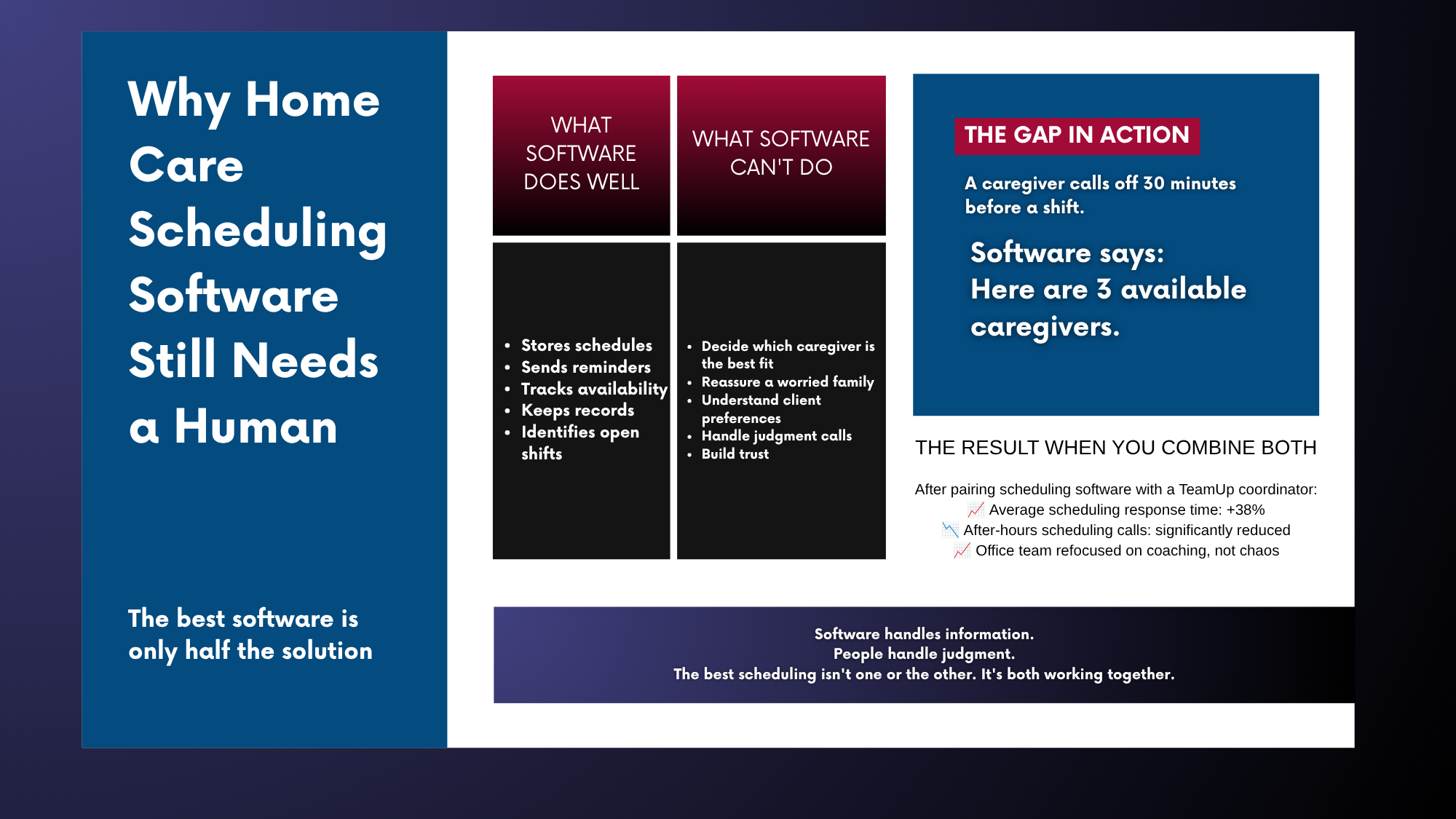
One lesson I learned pretty quickly is that software is excellent at storing information. It remembers schedules, sends reminders, tracks availability, and keeps records. What it cannot do is understand the hundreds of little decisions that happen inside a home care agency every single day.
When one caregiver cancels, should we send the closest available caregiver or the one who already knows the client? If a client prefers consistency over speed, which assignment matters more? Should we split two visits or protect continuity of care? Those decisions require judgment that only a trained scheduler brings.
The Agency for Healthcare Research and Quality explains that care coordination depends heavily on communication and informed decision-making, not simply information management (AHRQ, 2020). That perfectly described what I was experiencing. Our home health care scheduling software gave us data. Our scheduling coordinator turned that data into action.
Schedules break because life happens.
Early on, I blamed our scheduling software every time something went wrong. Eventually, I realized the software wasn’t failing. Life was simply more unpredictable than I expected. Here’s our common realities: caregivers get stuck in traffic, while clients need emergency appointments and families call asking to move visits. None of those situations fit neatly into an automated workflow.
The World Health Organization has consistently emphasized that healthcare delivery depends on adaptable workforce management because patient needs constantly change (WHO, 2022). That flexibility cannot be fully automated.
I recall one afternoon, our office received four caregiver call-offs within two hours after a stomach virus spread through several households. The software showed every available caregiver. It could not decide which reassignment would create the least disruption for families. This is exactly the kind of real-time crisis management that software can’t handle on its own.
Our coordinator knew which caregivers had previously worked with each client, who was comfortable with memory care, who preferred longer shifts, and who lived close enough to arrive quickly. Those decisions protected relationships, and helped us avoid the missed visits that come from mismatched reassignments. Software alone could not have done that.
Communication is still a human skill.
This might have surprised me more than anything else. I assumed automation would eliminate communication problems. Instead, I realized automation actually made good communication even more important.
Do not forget that families don’t just want notifications. They want reassurance. Caregivers don’t just want updated schedules. They want someone who understands why a change happened. Referral partners don’t simply want confirmation emails. They want confidence that their patients are receiving dependable care.
Research published by the American Hospital Association highlights that communication remains one of the strongest contributors to operational performance across healthcare organizations (AHA, 2022). Technology helps communication happen faster. People make communication meaningful.
Everytime I mention this, one family still comes to mind. Their regular caregiver experienced a family emergency. Our home health care scheduling software immediately identified three available replacements. Our coordinator chose the caregiver who had previously filled in for the client six months earlier. Before confirming the assignment, she personally called the family to explain the situation. The daughter later told us that the phone call mattered far more than the replacement itself. That conversation protected trust. No software could have known that.
The best results came when we combined software with TeamUp.
The biggest improvement in our operations did not happen when we upgraded software. It happened when we paired the software with people who knew how to use it well. That was my experience after partnering with TeamUp.
At first, I assumed their role would mostly involve data entry and scheduling support. Instead, they became an extension of our operational team. Their scheduling coordinators understood caregiver availability, client preferences, travel logistics, and escalation procedures before situations became emergencies.
The first few weeks really changed my perspective. We were onboarding six new clients while managing several caregiver vacations. Normally, our office would have spent the entire week catching up. Instead, TeamUp coordinated schedule confirmations, documented every caregiver communication, updated assignments inside our home health care scheduling software, and flagged conflicts before they reached our office managers.
I compared our monthly reports afterward. Average scheduling response time improved by 38 percent. After-hours scheduling calls dropped noticeably because more issues had already been resolved during the day. Most importantly, my office managers finally had time to focus on caregiver coaching instead of spending every hour moving shifts around.
TeamUp never replaced our software. They unlocked its value. That distinction became incredibly important to me.
Technology should help you lead, not replace leadership.
I think many agency owners buy software hoping it will eliminate complexity. I certainly did. Now I see technology differently. Software handles repetitive work exceptionally well. People handle judgment. Software tracks information. People build relationships. Software identifies available caregivers. People understand which caregiver is actually the best fit.
The Home Care Association of America notes that technology adoption delivers the strongest operational improvements when paired with effective workflow management rather than treated as a standalone solution (HCAOA, 2023). That perfectly reflects my experience.
Today, when another agency owner asks whether investing in home health care scheduling software is worthwhile, I always answer yes. Then I add something I wish someone had told me earlier. The software is only half of the investment. The people managing it are the other half. Ignoring either one limits the value of both.
If there is one lesson I have learned, it is this. The best home health care scheduling software is not the one with the longest list of features. It is the one supported by people who know exactly how to turn those features into better care.
To see how experienced coordinators can help you get more value from the software you already have, visit TeamUp’s Healthcare Virtual Assistant Services to learn more.
References
Agency for Healthcare Research and Quality. (2020). Care Coordination Measures Atlas. U.S. Department of Health and Human Services.
American Hospital Association. (2022). Reducing Administrative Burden in Health Care Organizations.
Home Care Association of America. (2023). 2023 Home Care Benchmarking Study.
World Health Organization. (2022). Health and Care Workforce: Strategic Directions.
When I invested in home health care scheduling software, I thought technology would solve our scheduling challenges. It certainly helped, but I quickly learned that software alone cannot make judgment calls, reassure families, or respond thoughtfully to unexpected changes. In this article, I share the lessons I learned about why skilled scheduling coordinators remain essential, even with the best technology. I also explain how partnering with TeamUp helped us get more value from our scheduling software by combining smart tools with experienced people. If you’re evaluating scheduling solutions, this perspective may save you from the same mistake I made.
When we invested in home health care scheduling software, I honestly thought we had solved one of the biggest headaches in our agency. The sales demo looked amazing. Caregiver schedules updated instantly. Notifications were automated. Availability was tracked in real time. Everything looked smoother, faster, and smarter than the spreadsheets we had been using.
For the first couple of weeks, I was convinced this was the answer. Then real life happened. Early this year, a caregiver called in sick thirty minutes before a morning shift. A family requested a last-minute schedule change because of a doctor’s appointment. To top it all off, two caregivers accidentally accepted overlapping assignments. Suddenly, I realized something important.
The software knew what was happening. It just didn’t know what to do about it. That was the moment I stopped expecting technology to replace people and started thinking about how technology should support them instead.
Great software organizes information, but great coordinators make decisions.
One lesson I learned pretty quickly is that software is excellent at storing information. It remembers schedules, sends reminders, tracks availability, and keeps records. What it cannot do is understand the hundreds of little decisions that happen inside a home care agency every single day.
When one caregiver cancels, should we send the closest available caregiver or the one who already knows the client? If a client prefers consistency over speed, which assignment matters more? Should we split two visits or protect continuity of care? Those decisions require judgment that only a trained scheduler brings.
The Agency for Healthcare Research and Quality explains that care coordination depends heavily on communication and informed decision-making, not simply information management (AHRQ, 2020). That perfectly described what I was experiencing. Our home health care scheduling software gave us data. Our scheduling coordinator turned that data into action.
Schedules break because life happens.
Early on, I blamed our scheduling software every time something went wrong. Eventually, I realized the software wasn’t failing. Life was simply more unpredictable than I expected. Here’s our common realities: caregivers get stuck in traffic, while clients need emergency appointments and families call asking to move visits. None of those situations fit neatly into an automated workflow.
The World Health Organization has consistently emphasized that healthcare delivery depends on adaptable workforce management because patient needs constantly change (WHO, 2022). That flexibility cannot be fully automated.
I recall one afternoon, our office received four caregiver call-offs within two hours after a stomach virus spread through several households. The software showed every available caregiver. It could not decide which reassignment would create the least disruption for families. This is exactly the kind of real-time crisis management that software can’t handle on its own.
Our coordinator knew which caregivers had previously worked with each client, who was comfortable with memory care, who preferred longer shifts, and who lived close enough to arrive quickly. Those decisions protected relationships, and helped us avoid the missed visits that come from mismatched reassignments. Software alone could not have done that.
Communication is still a human skill.
This might have surprised me more than anything else. I assumed automation would eliminate communication problems. Instead, I realized automation actually made good communication even more important.
Do not forget that families don’t just want notifications. They want reassurance. Caregivers don’t just want updated schedules. They want someone who understands why a change happened. Referral partners don’t simply want confirmation emails. They want confidence that their patients are receiving dependable care.
Research published by the American Hospital Association highlights that communication remains one of the strongest contributors to operational performance across healthcare organizations (AHA, 2022). Technology helps communication happen faster. People make communication meaningful.
Everytime I mention this, one family still comes to mind. Their regular caregiver experienced a family emergency. Our home health care scheduling software immediately identified three available replacements. Our coordinator chose the caregiver who had previously filled in for the client six months earlier. Before confirming the assignment, she personally called the family to explain the situation. The daughter later told us that the phone call mattered far more than the replacement itself. That conversation protected trust. No software could have known that.
The best results came when we combined software with TeamUp.
The biggest improvement in our operations did not happen when we upgraded software. It happened when we paired the software with people who knew how to use it well. That was my experience after partnering with TeamUp.
At first, I assumed their role would mostly involve data entry and scheduling support. Instead, they became an extension of our operational team. Their scheduling coordinators understood caregiver availability, client preferences, travel logistics, and escalation procedures before situations became emergencies.
The first few weeks really changed my perspective. We were onboarding six new clients while managing several caregiver vacations. Normally, our office would have spent the entire week catching up. Instead, TeamUp coordinated schedule confirmations, documented every caregiver communication, updated assignments inside our home health care scheduling software, and flagged conflicts before they reached our office managers.
I compared our monthly reports afterward. Average scheduling response time improved by 38 percent. After-hours scheduling calls dropped noticeably because more issues had already been resolved during the day. Most importantly, my office managers finally had time to focus on caregiver coaching instead of spending every hour moving shifts around.
TeamUp never replaced our software. They unlocked its value. That distinction became incredibly important to me.
Technology should help you lead, not replace leadership.
I think many agency owners buy software hoping it will eliminate complexity. I certainly did. Now I see technology differently. Software handles repetitive work exceptionally well. People handle judgment. Software tracks information. People build relationships. Software identifies available caregivers. People understand which caregiver is actually the best fit.
The Home Care Association of America notes that technology adoption delivers the strongest operational improvements when paired with effective workflow management rather than treated as a standalone solution (HCAOA, 2023). That perfectly reflects my experience.
Today, when another agency owner asks whether investing in home health care scheduling software is worthwhile, I always answer yes. Then I add something I wish someone had told me earlier. The software is only half of the investment. The people managing it are the other half. Ignoring either one limits the value of both.
If there is one lesson I have learned, it is this. The best home health care scheduling software is not the one with the longest list of features. It is the one supported by people who know exactly how to turn those features into better care.
To see how experienced coordinators can help you get more value from the software you already have, visit TeamUp’s Healthcare Virtual Assistant Services to learn more.
References
Agency for Healthcare Research and Quality. (2020). Care Coordination Measures Atlas. U.S. Department of Health and Human Services.
American Hospital Association. (2022). Reducing Administrative Burden in Health Care Organizations.
Home Care Association of America. (2023). 2023 Home Care Benchmarking Study.
World Health Organization. (2022). Health and Care Workforce: Strategic Directions.
Sorry, the comment form is closed at this time.