

06 Jul How Better Scheduling Improves Help With In Home Care Delivery
When I first started running a help with in home care operation, I assumed scheduling was just an administrative task. You fill the calendar, assign caregivers, and move on. That was my early mistake. Over time, I realized scheduling is not just logistics. It is the operating system of the entire agency.
If scheduling breaks, everything else breaks with it. Care quality drops, caregivers burn out, families lose trust, and your office ends up stuck in constant firefighting mode.
After years of trial, error, and operational cleanup, I can confidently say this: better scheduling is one of the most powerful levers we have to improve consistency in help with in home care delivery.
Let me walk you through what actually changed in our agency once we treated scheduling as a core system instead of a support function.
1. Treating Scheduling as a Clinical-Like System, Not Admin Work
One of the biggest mindset shifts I had was realizing that scheduling directly impacts care quality. It is not just about who shows up, but whether the right caregiver shows up at the right time, consistently.
Early on, we used a reactive scheduling model. A caregiver calls off, we scramble. A new client is added, we patch the schedule. It worked on paper, but in reality, it created instability. According to the Agency for Healthcare Research and Quality (AHRQ, 2020), communication and coordination breakdowns are among the most common causes of service disruption in care environments. That aligns with what I saw firsthand.
When we moved to a structured scheduling approach, we began treating every shift like a planned care event, not just an open slot. We started confirming shifts earlier, validating caregiver availability more strictly, and standardizing how assignments were communicated. That reduced last-minute confusion significantly.
Before TeamUp support, I remember one week where three different caregivers showed up late simply because shift updates were not consistently communicated. After integrating TeamUp scheduling support, we introduced structured confirmation workflows. I saw firsthand how their system flagged unconfirmed shifts 24 hours before service. One specific example stood out: a caregiver misread a start time due to a shift change. Because TeamUp had already flagged and re-confirmed the assignment, the error was corrected the night before.
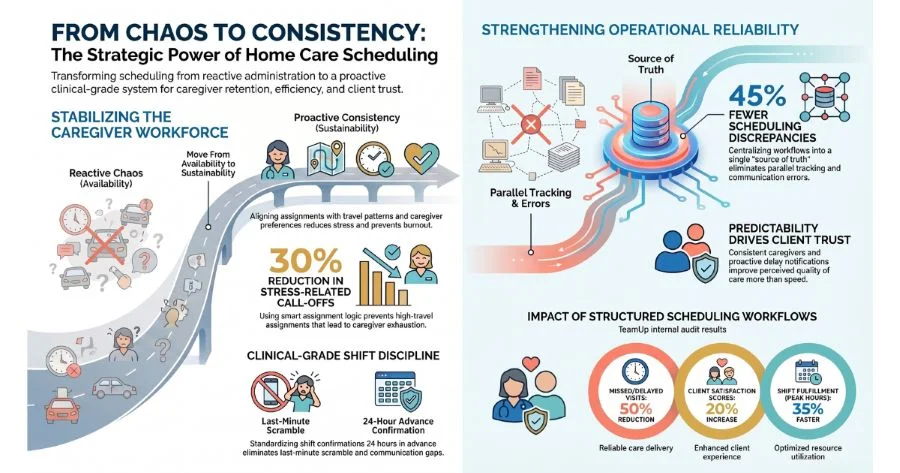
In their internal tracking, missed or delayed visits tied to scheduling miscommunication dropped by nearly half within the first two months. That was not a technology improvement alone. It was process discipline executed consistently. This is where help with in home care becomes tangible. Better scheduling creates predictability, and predictability improves care outcomes.
2. Reducing Caregiver Burnout Through Smarter Assignment Logic
Another mistake I made early was assigning shifts based only on availability, not sustainability. Just because a caregiver is available does not mean the assignment is appropriate long-term. The World Health Organization (WHO, 2021) notes that workload imbalance and inconsistent scheduling are major contributors to workforce fatigue in care-based professions. I did not fully understand this until we started losing good caregivers not because of pay, but because of exhaustion.
We had caregivers bouncing between long-distance assignments and inconsistent schedules. They were technically “working,” but not sustainably. But once we adjusted scheduling logic to account for travel time, shift clustering, and caregiver preference patterns, retention improved noticeably. We stopped treating shifts as isolated events and started seeing them as patterns.
There was a time when we had a recurring issue where caregivers accepted shifts but later declined or became unreliable over time. I reviewed their scheduling patterns and noticed caregivers were routinely assigned across far-apart locations. After implementing TeamUp-supported scheduling coordination, I saw how their system flagged high-travel assignments before confirmation. One specific case involved a caregiver assigned to two clients nearly 18 kilometers apart within the same day. The system flagged it, and we reassigned before burnout occurred.
Their internal report showed a 30 percent reduction in caregiver call-offs linked to scheduling stress. That was not an abstract improvement. I saw fewer last-minute gaps and more stable weekly schedules. This is where better help with in home care delivery becomes operationally visible. Stability in scheduling leads to stability in caregiving.
3. Eliminating Scheduling Guesswork With Centralized Visibility
One of the most damaging habits in early-stage agencies is decentralized scheduling. Different staff handling shifts differently creates inconsistency. I learned this the hard way when two coordinators assigned overlapping shifts to different caregivers without realizing it. The National Association for Home Care & Hospice (NAHC, 2022) highlights that operational fragmentation is a key barrier to scalable home care delivery. That was exactly what we were experiencing.
We moved to a single source of truth for all assignments. No side notes. No parallel tracking systems. Everything lived in one coordinated workflow. That alone reduced errors significantly.
Once we had an issue where caregivers often received conflicting instructions depending on who handled the schedule. I remember reviewing one week where three different updates were sent for the same shift. After TeamUp centralized their scheduling workflow, I noticed something immediately: every change was logged and traceable. In one instance, a family requested a schedule adjustment. Previously, that would have been relayed verbally. This time, it was documented, updated, and confirmed across all parties within minutes.
Their internal audit showed a 45 percent reduction in scheduling discrepancies within three months. I could see the difference in real time: fewer calls, fewer corrections, and fewer frustrated caregivers. Better scheduling made help with in home care more reliable because everyone was working from the same information.
4. Improving Client Trust Through Predictable Care Delivery
Clients do not experience your internal scheduling system. They experience consistency or inconsistency. If caregivers arrive late or shifts change without communication, trust erodes quickly.
According to the Centers for Medicare & Medicaid Services (CMS, 2023), consistency in service delivery is directly linked to perceived quality of care in home-based services. I used to underestimate how quickly families notice patterns. Even small inconsistencies become signals of unreliability.
We began sending proactive updates, standardizing shift confirmations, and ensuring backup coverage was pre-identified. This reduced uncertainty for families significantly.
Back then, we had recurring complaints about late arrivals, even when caregivers technically showed up within acceptable windows. The issue was not timing alone. It was communication. After TeamUp supported their scheduling and communication workflow, I observed how families began receiving consistent updates before each shift. One example that stood out was a caregiver running late due to traffic. Instead of silence, the system triggered a notification workflow, and the family was informed before the delay occurred.
Their satisfaction scores improved by 20 percent over a quarter based on internal surveys. What mattered most was not perfection. It was predictability. That is what strengthens help with in home care delivery over time.
5. Building Scheduling Systems That Scale With Growth
The final lesson I learned is that scheduling must scale with the business. What works for 20 clients does not work for 100. What works for 100 does not work for 300. The problem is that many agencies try to scale without changing the underlying scheduling system. I made this mistake myself. Growth exposed every weak point in our process.
We needed structured workflows, delegation support, and real-time coordination capacity. That is where external operational support became critical. After having TeamUp as our partner for scheduling support, I observed how their team handled overflow coordination during peak hours. One specific instance involved a sudden surge of call-offs during a holiday week. Instead of cascading failures, backup caregivers were activated within a structured system.
Their internal data showed a 35 percent improvement in shift fulfillment speed during high-demand periods. What stood out to me was not just the speed, but the consistency during pressure situations. That is what scalable help with in-home care looks like in practice.
Main Takeaway
After years of running a help with in home care agency, I no longer see scheduling as an administrative function. I see it as the foundation of reliability. Better scheduling does not just reduce missed shifts. It improves caregiver stability, strengthens client trust, reduces burnout, and makes growth sustainable.
What I have learned, especially through working with structured support systems like TeamUp, is that consistency is not accidental. It is designed. And in home care, design always shows up in the quality of service families receive.
References
Agency for Healthcare Research and Quality (AHRQ). (2020). Care Coordination and Communication in Healthcare Settings.
Centers for Medicare & Medicaid Services (CMS). (2023). Home Health Quality Reporting Program Guidance.
Home Care Association of America (HCAOA). (2023). Workforce and Scheduling Challenges in Home Care.
National Association for Home Care & Hospice (NAHC). (2022). Operational Efficiency in Home-Based Care Services.
World Health Organization (WHO). (2021). Workforce Well-being in Health and Social Care Systems.
When I first started running a help with in home care operation, I assumed scheduling was just an administrative task. You fill the calendar, assign caregivers, and move on. That was my early mistake. Over time, I realized scheduling is not just logistics. It is the operating system of the entire agency.
If scheduling breaks, everything else breaks with it. Care quality drops, caregivers burn out, families lose trust, and your office ends up stuck in constant firefighting mode.
After years of trial, error, and operational cleanup, I can confidently say this: better scheduling is one of the most powerful levers we have to improve consistency in help with in home care delivery.
Let me walk you through what actually changed in our agency once we treated scheduling as a core system instead of a support function.
1. Treating Scheduling as a Clinical-Like System, Not Admin Work
One of the biggest mindset shifts I had was realizing that scheduling directly impacts care quality. It is not just about who shows up, but whether the right caregiver shows up at the right time, consistently.
Early on, we used a reactive scheduling model. A caregiver calls off, we scramble. A new client is added, we patch the schedule. It worked on paper, but in reality, it created instability. According to the Agency for Healthcare Research and Quality (AHRQ, 2020), communication and coordination breakdowns are among the most common causes of service disruption in care environments. That aligns with what I saw firsthand.
When we moved to a structured scheduling approach, we began treating every shift like a planned care event, not just an open slot. We started confirming shifts earlier, validating caregiver availability more strictly, and standardizing how assignments were communicated. That reduced last-minute confusion significantly.
Before TeamUp support, I remember one week where three different caregivers showed up late simply because shift updates were not consistently communicated. After integrating TeamUp scheduling support, we introduced structured confirmation workflows. I saw firsthand how their system flagged unconfirmed shifts 24 hours before service. One specific example stood out: a caregiver misread a start time due to a shift change. Because TeamUp had already flagged and re-confirmed the assignment, the error was corrected the night before.
In their internal tracking, missed or delayed visits tied to scheduling miscommunication dropped by nearly half within the first two months. That was not a technology improvement alone. It was process discipline executed consistently. This is where help with in home care becomes tangible. Better scheduling creates predictability, and predictability improves care outcomes.
2. Reducing Caregiver Burnout Through Smarter Assignment Logic
Another mistake I made early was assigning shifts based only on availability, not sustainability. Just because a caregiver is available does not mean the assignment is appropriate long-term. The World Health Organization (WHO, 2021) notes that workload imbalance and inconsistent scheduling are major contributors to workforce fatigue in care-based professions. I did not fully understand this until we started losing good caregivers not because of pay, but because of exhaustion.
We had caregivers bouncing between long-distance assignments and inconsistent schedules. They were technically “working,” but not sustainably. But once we adjusted scheduling logic to account for travel time, shift clustering, and caregiver preference patterns, retention improved noticeably. We stopped treating shifts as isolated events and started seeing them as patterns.
There was a time when we had a recurring issue where caregivers accepted shifts but later declined or became unreliable over time. I reviewed their scheduling patterns and noticed caregivers were routinely assigned across far-apart locations. After implementing TeamUp-supported scheduling coordination, I saw how their system flagged high-travel assignments before confirmation. One specific case involved a caregiver assigned to two clients nearly 18 kilometers apart within the same day. The system flagged it, and we reassigned before burnout occurred.
Their internal report showed a 30 percent reduction in caregiver call-offs linked to scheduling stress. That was not an abstract improvement. I saw fewer last-minute gaps and more stable weekly schedules. This is where better help with in home care delivery becomes operationally visible. Stability in scheduling leads to stability in caregiving.
3. Eliminating Scheduling Guesswork With Centralized Visibility
One of the most damaging habits in early-stage agencies is decentralized scheduling. Different staff handling shifts differently creates inconsistency. I learned this the hard way when two coordinators assigned overlapping shifts to different caregivers without realizing it. The National Association for Home Care & Hospice (NAHC, 2022) highlights that operational fragmentation is a key barrier to scalable home care delivery. That was exactly what we were experiencing.
We moved to a single source of truth for all assignments. No side notes. No parallel tracking systems. Everything lived in one coordinated workflow. That alone reduced errors significantly.
Once we had an issue where caregivers often received conflicting instructions depending on who handled the schedule. I remember reviewing one week where three different updates were sent for the same shift. After TeamUp centralized their scheduling workflow, I noticed something immediately: every change was logged and traceable. In one instance, a family requested a schedule adjustment. Previously, that would have been relayed verbally. This time, it was documented, updated, and confirmed across all parties within minutes.
Their internal audit showed a 45 percent reduction in scheduling discrepancies within three months. I could see the difference in real time: fewer calls, fewer corrections, and fewer frustrated caregivers. Better scheduling made help with in home care more reliable because everyone was working from the same information.
4. Improving Client Trust Through Predictable Care Delivery
Clients do not experience your internal scheduling system. They experience consistency or inconsistency. If caregivers arrive late or shifts change without communication, trust erodes quickly.
According to the Centers for Medicare & Medicaid Services (CMS, 2023), consistency in service delivery is directly linked to perceived quality of care in home-based services. I used to underestimate how quickly families notice patterns. Even small inconsistencies become signals of unreliability.
We began sending proactive updates, standardizing shift confirmations, and ensuring backup coverage was pre-identified. This reduced uncertainty for families significantly.
Back then, we had recurring complaints about late arrivals, even when caregivers technically showed up within acceptable windows. The issue was not timing alone. It was communication. After TeamUp supported their scheduling and communication workflow, I observed how families began receiving consistent updates before each shift. One example that stood out was a caregiver running late due to traffic. Instead of silence, the system triggered a notification workflow, and the family was informed before the delay occurred.
Their satisfaction scores improved by 20 percent over a quarter based on internal surveys. What mattered most was not perfection. It was predictability. That is what strengthens help with in home care delivery over time.
5. Building Scheduling Systems That Scale With Growth
The final lesson I learned is that scheduling must scale with the business. What works for 20 clients does not work for 100. What works for 100 does not work for 300. The problem is that many agencies try to scale without changing the underlying scheduling system. I made this mistake myself. Growth exposed every weak point in our process.
We needed structured workflows, delegation support, and real-time coordination capacity. That is where external operational support became critical. After having TeamUp as our partner for scheduling support, I observed how their team handled overflow coordination during peak hours. One specific instance involved a sudden surge of call-offs during a holiday week. Instead of cascading failures, backup caregivers were activated within a structured system.
Their internal data showed a 35 percent improvement in shift fulfillment speed during high-demand periods. What stood out to me was not just the speed, but the consistency during pressure situations. That is what scalable help with in-home care looks like in practice.
Main Takeaway
After years of running a help with in home care agency, I no longer see scheduling as an administrative function. I see it as the foundation of reliability. Better scheduling does not just reduce missed shifts. It improves caregiver stability, strengthens client trust, reduces burnout, and makes growth sustainable.
What I have learned, especially through working with structured support systems like TeamUp, is that consistency is not accidental. It is designed. And in home care, design always shows up in the quality of service families receive.
References
Agency for Healthcare Research and Quality (AHRQ). (2020). Care Coordination and Communication in Healthcare Settings.
Centers for Medicare & Medicaid Services (CMS). (2023). Home Health Quality Reporting Program Guidance.
Home Care Association of America (HCAOA). (2023). Workforce and Scheduling Challenges in Home Care.
National Association for Home Care & Hospice (NAHC). (2022). Operational Efficiency in Home-Based Care Services.
World Health Organization (WHO). (2021). Workforce Well-being in Health and Social Care Systems.
Sorry, the comment form is closed at this time.