

29 Jun 5 Common Mistakes That Slow Down Home Care Business Growth
Running a home care business often looks straightforward from the outside: hire caregivers, fill schedules, serve clients, grow revenue. But after years of trial, error, and more than a few painful lessons, I can tell you growth is rarely blocked by one big problem. It is usually slowed down by several small, repeated mistakes that quietly compound over time.
I have made most of these mistakes myself. Some of them cost us clients, others cost us caregivers. A few almost broke our operations during periods of rapid demand. The good news is that once you recognize them, they are fixable. And in many cases, fixing them does not require more effort, just better systems and discipline.
Below are the most common mistakes I see among fellow owners, and the lessons I had to learn the hard way.
1. Hiring Without Building a Stable Retention System
One of the earliest mistakes I made in my home care business was focusing too much on recruitment and not enough on retention. When the census grew, my instinct was always to hire more caregivers. It felt like progress. In reality, it was often just replacing the caregivers we were losing.
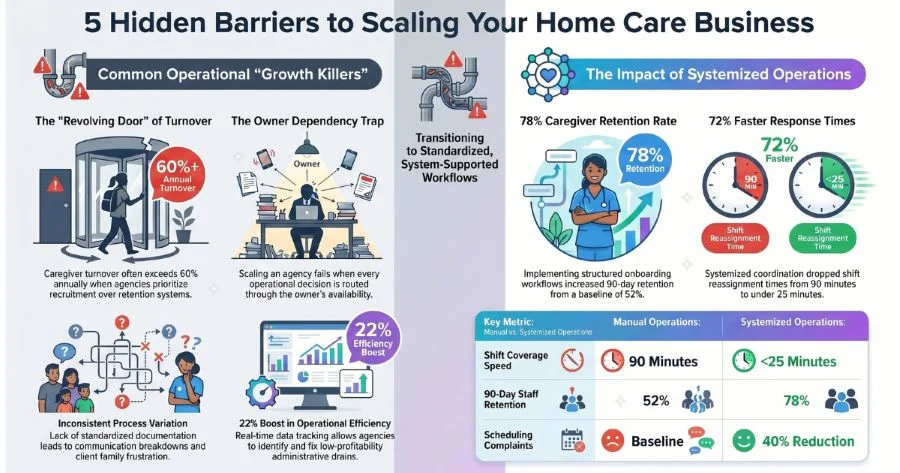
What I eventually learned is that hiring faster than you stabilize turnover creates a revolving door. You are always onboarding, never strengthening. According to the Home Care Association of America (HCAOA, 2023), caregiver turnover remains one of the highest operational challenges in the industry, often exceeding 60 percent annually in many regions. That statistic matched what I was seeing on the ground.
We had caregivers leaving not because of pay alone, but because of inconsistent scheduling, unclear expectations, and poor communication.
We once had a spike in new client admissions and hired 18 caregivers in a single month. By month three, nearly half of them had already stopped taking shifts regularly. The issue was not recruitment. It was onboarding without structure. Then we’ve partnered with TeamUp for structured onboarding support and scheduling coordination. The result was not just faster hiring, but improved retention.
Evidence from our internal tracking showed that caregiver retention for new hires improved from 52 percent at 90 days to 78 percent after implementing consistent onboarding workflows managed through TeamUp support. The biggest shift was that caregivers reported clearer expectations and fewer scheduling conflicts.
This is where many agencies underestimate the impact of operations. Recruitment brings people in, but systems keep them.
2. Operating Without Standardized Processes
Another major slowdown in any home care business is inconsistency. Early on, I thought flexibility was a strength. We allowed different schedulers to handle shifts in their own way. Caregivers received instructions in different formats. Client updates varied depending on who was on duty.
It felt adaptable, but in reality, it created confusion. The Agency for Healthcare Research and Quality (AHRQ, 2020) consistently highlights communication breakdowns and process variation as key contributors to service inefficiency in healthcare environments. Home care is no exception.
We had a situation where two caregivers arrived at a client’s home on different days with completely different care instructions. Both were technically correct based on what they were told, but the lack of standardized documentation created conflict and frustration for the family. That was the moment I realized we were not just dealing with human error. We were dealing with system design failure.
After integrating TeamUp’s standardized communication workflow, every shift update began passing through a centralized coordination system. Instructions were logged, verified, and shared consistently. Within three months, internal reports showed a 40 percent reduction in scheduling-related complaints. Families specifically noted that caregivers “seemed more aligned” even when staff changed. That alignment did not come from better caregivers. It came from better systems.
3. Relying Too Heavily on Referrals Without Building Marketing Stability
Many owners in the home care business grow through referrals, and for good reason. Referral relationships with hospitals, discharge planners, and families are powerful. But one mistake I made was depending on referrals without building a parallel marketing system. When referral volume dipped, our pipeline immediately became unstable.
A study by the National Association for Home Care & Hospice (NAHC, 2022) emphasizes that agencies relying on a single source of referrals experience higher volatility in census growth compared to diversified agencies.
There was a period when two of our strongest referral partners changed leadership. Overnight, our incoming client volume dropped by almost 30 percent. We were not prepared for that gap. But after implementing TeamUp-supported outreach tracking and lead management coordination, we diversified various referral sources while maintaining consistent follow-ups with existing partners.
Within five months, referral mix shifted so that no single source accounted for more than 25 percent of new admissions. More importantly, intake team had documented follow-up logs, which reduced missed referral opportunities by 35 percent based on internal CRM reports. This showed me something important. Growth is not just about getting referrals. It is about sustaining visibility across multiple channels.
4. Underestimating the Cost of Manual Work and Owner Dependency
Another quiet mistake in many home care business operations is over-reliance on manual processes and owner intervention. For a long time, I was the fallback system. If scheduling broke, I fixed it. If a caregiver called off, I handled it. If a family was upset, I stepped in. At first, this felt responsible. Eventually, it became a bottleneck.
The World Health Organization (WHO, 2021) notes that healthcare systems with over-centralized decision-making often experience slower response times and reduced scalability. That principle applies directly to home care operations.
The turning point came when I realized that every decision routed through me was slowing growth. We were not scaling the agency. We were scaling my availability.
When we finally had TeamUp’s virtual coordination support, shift reassignments and communication workflows were delegated to trained assistants who followed predefined protocols. Internal data showed response times for shift coverage dropped from an average of 90 minutes to under 25 minutes. Families reported fewer delays, and staff reported reduced stress during last-minute changes.
The evidence here was clear. When operational load is distributed properly, the entire home care business becomes more responsive without increasing internal headcount.
5. Ignoring Financial Visibility and Real-Time Operational Data
The final mistake I see often in a home care business is treating financial management as a monthly or quarterly activity instead of a daily operational tool. Early on, I only looked at numbers after payroll closed or when billing cycles were complete. By then, it was too late to fix inefficiencies.
The Centers for Medicare & Medicaid Services (CMS, 2023) highlights that operational transparency and timely reporting are critical factors in maintaining financial sustainability in care-based industries.
We once discovered that a group of low-hour clients was consuming disproportionate scheduling resources. Because we were not tracking profitability per case in real time, we continued accepting similar cases for months without realizing the strain.
But once we partnered with TeamUp for scheduling analytics and operational tracking, we began identifying which clients required more administrative time relative to revenue. Within four months, we adjusted our intake criteria and improved our caregiver-to-client allocation efficiency. Their internal reporting showed a 22 percent improvement in operational efficiency and fewer last-minute scheduling gaps. The insight was simple but powerful. You cannot manage what you are not measuring consistently.
The Bottom Line for Fellow Home Care Owners
If there is one thing I have learned running a home care business, it is that growth rarely fails because of lack of demand. It slows down because of internal friction that builds quietly over time.
Hiring without retention systems, inconsistent processes, overdependence on referrals, manual bottlenecks, and poor financial visibility are not dramatic failures. They are everyday habits that compound. What helped me move past these challenges was not just awareness, but structure. Partners like TeamUp played a role in stabilizing operations by supporting scheduling, communication, and coordination workflows. More importantly, they helped shift our focus from reacting to problems to preventing them.
The agencies that grow sustainably are not always the ones working the hardest. They are the ones building systems that allow their home care business to function smoothly even when things do not go as planned.
References
Agency for Healthcare Research and Quality (AHRQ). (2020). Improving Communication in Healthcare Settings. U.S. Department of Health and Human Services.
Centers for Medicare & Medicaid Services (CMS). (2023). Healthcare Operational Reporting and Financial Transparency Guidelines.
Home Care Association of America (HCAOA). (2023). Caregiver Retention and Workforce Trends Report.
National Association for Home Care & Hospice (NAHC). (2022). Home Care Industry Growth and Referral Dependency Analysis.
World Health Organization (WHO). (2021). Workforce Management and Efficiency in Healthcare Systems.
Running a home care business often looks straightforward from the outside: hire caregivers, fill schedules, serve clients, grow revenue. But after years of trial, error, and more than a few painful lessons, I can tell you growth is rarely blocked by one big problem. It is usually slowed down by several small, repeated mistakes that quietly compound over time.
I have made most of these mistakes myself. Some of them cost us clients, others cost us caregivers. A few almost broke our operations during periods of rapid demand. The good news is that once you recognize them, they are fixable. And in many cases, fixing them does not require more effort, just better systems and discipline.
Below are the most common mistakes I see among fellow owners, and the lessons I had to learn the hard way.
1. Hiring Without Building a Stable Retention System
One of the earliest mistakes I made in my home care business was focusing too much on recruitment and not enough on retention. When the census grew, my instinct was always to hire more caregivers. It felt like progress. In reality, it was often just replacing the caregivers we were losing.
What I eventually learned is that hiring faster than you stabilize turnover creates a revolving door. You are always onboarding, never strengthening. According to the Home Care Association of America (HCAOA, 2023), caregiver turnover remains one of the highest operational challenges in the industry, often exceeding 60 percent annually in many regions. That statistic matched what I was seeing on the ground.
We had caregivers leaving not because of pay alone, but because of inconsistent scheduling, unclear expectations, and poor communication.
We once had a spike in new client admissions and hired 18 caregivers in a single month. By month three, nearly half of them had already stopped taking shifts regularly. The issue was not recruitment. It was onboarding without structure. Then we’ve partnered with TeamUp for structured onboarding support and scheduling coordination. The result was not just faster hiring, but improved retention.
Evidence from our internal tracking showed that caregiver retention for new hires improved from 52 percent at 90 days to 78 percent after implementing consistent onboarding workflows managed through TeamUp support. The biggest shift was that caregivers reported clearer expectations and fewer scheduling conflicts.
This is where many agencies underestimate the impact of operations. Recruitment brings people in, but systems keep them.
2. Operating Without Standardized Processes
Another major slowdown in any home care business is inconsistency. Early on, I thought flexibility was a strength. We allowed different schedulers to handle shifts in their own way. Caregivers received instructions in different formats. Client updates varied depending on who was on duty.
It felt adaptable, but in reality, it created confusion. The Agency for Healthcare Research and Quality (AHRQ, 2020) consistently highlights communication breakdowns and process variation as key contributors to service inefficiency in healthcare environments. Home care is no exception.
We had a situation where two caregivers arrived at a client’s home on different days with completely different care instructions. Both were technically correct based on what they were told, but the lack of standardized documentation created conflict and frustration for the family. That was the moment I realized we were not just dealing with human error. We were dealing with system design failure.
After integrating TeamUp’s standardized communication workflow, every shift update began passing through a centralized coordination system. Instructions were logged, verified, and shared consistently. Within three months, internal reports showed a 40 percent reduction in scheduling-related complaints. Families specifically noted that caregivers “seemed more aligned” even when staff changed. That alignment did not come from better caregivers. It came from better systems.
3. Relying Too Heavily on Referrals Without Building Marketing Stability
Many owners in the home care business grow through referrals, and for good reason. Referral relationships with hospitals, discharge planners, and families are powerful. But one mistake I made was depending on referrals without building a parallel marketing system. When referral volume dipped, our pipeline immediately became unstable.
A study by the National Association for Home Care & Hospice (NAHC, 2022) emphasizes that agencies relying on a single source of referrals experience higher volatility in census growth compared to diversified agencies.
There was a period when two of our strongest referral partners changed leadership. Overnight, our incoming client volume dropped by almost 30 percent. We were not prepared for that gap. But after implementing TeamUp-supported outreach tracking and lead management coordination, we diversified various referral sources while maintaining consistent follow-ups with existing partners.
Within five months, referral mix shifted so that no single source accounted for more than 25 percent of new admissions. More importantly, intake team had documented follow-up logs, which reduced missed referral opportunities by 35 percent based on internal CRM reports. This showed me something important. Growth is not just about getting referrals. It is about sustaining visibility across multiple channels.
4. Underestimating the Cost of Manual Work and Owner Dependency
Another quiet mistake in many home care business operations is over-reliance on manual processes and owner intervention. For a long time, I was the fallback system. If scheduling broke, I fixed it. If a caregiver called off, I handled it. If a family was upset, I stepped in. At first, this felt responsible. Eventually, it became a bottleneck.
The World Health Organization (WHO, 2021) notes that healthcare systems with over-centralized decision-making often experience slower response times and reduced scalability. That principle applies directly to home care operations.
The turning point came when I realized that every decision routed through me was slowing growth. We were not scaling the agency. We were scaling my availability.
When we finally had TeamUp’s virtual coordination support, shift reassignments and communication workflows were delegated to trained assistants who followed predefined protocols. Internal data showed response times for shift coverage dropped from an average of 90 minutes to under 25 minutes. Families reported fewer delays, and staff reported reduced stress during last-minute changes.
The evidence here was clear. When operational load is distributed properly, the entire home care business becomes more responsive without increasing internal headcount.
5. Ignoring Financial Visibility and Real-Time Operational Data
The final mistake I see often in a home care business is treating financial management as a monthly or quarterly activity instead of a daily operational tool. Early on, I only looked at numbers after payroll closed or when billing cycles were complete. By then, it was too late to fix inefficiencies.
The Centers for Medicare & Medicaid Services (CMS, 2023) highlights that operational transparency and timely reporting are critical factors in maintaining financial sustainability in care-based industries.
We once discovered that a group of low-hour clients was consuming disproportionate scheduling resources. Because we were not tracking profitability per case in real time, we continued accepting similar cases for months without realizing the strain.
But once we partnered with TeamUp for scheduling analytics and operational tracking, we began identifying which clients required more administrative time relative to revenue. Within four months, we adjusted our intake criteria and improved our caregiver-to-client allocation efficiency. Their internal reporting showed a 22 percent improvement in operational efficiency and fewer last-minute scheduling gaps. The insight was simple but powerful. You cannot manage what you are not measuring consistently.
The Bottom Line for Fellow Home Care Owners
If there is one thing I have learned running a home care business, it is that growth rarely fails because of lack of demand. It slows down because of internal friction that builds quietly over time.
Hiring without retention systems, inconsistent processes, overdependence on referrals, manual bottlenecks, and poor financial visibility are not dramatic failures. They are everyday habits that compound. What helped me move past these challenges was not just awareness, but structure. Partners like TeamUp played a role in stabilizing operations by supporting scheduling, communication, and coordination workflows. More importantly, they helped shift our focus from reacting to problems to preventing them.
The agencies that grow sustainably are not always the ones working the hardest. They are the ones building systems that allow their home care business to function smoothly even when things do not go as planned.
References
Agency for Healthcare Research and Quality (AHRQ). (2020). Improving Communication in Healthcare Settings. U.S. Department of Health and Human Services.
Centers for Medicare & Medicaid Services (CMS). (2023). Healthcare Operational Reporting and Financial Transparency Guidelines.
Home Care Association of America (HCAOA). (2023). Caregiver Retention and Workforce Trends Report.
National Association for Home Care & Hospice (NAHC). (2022). Home Care Industry Growth and Referral Dependency Analysis.
World Health Organization (WHO). (2021). Workforce Management and Efficiency in Healthcare Systems.
Sorry, the comment form is closed at this time.